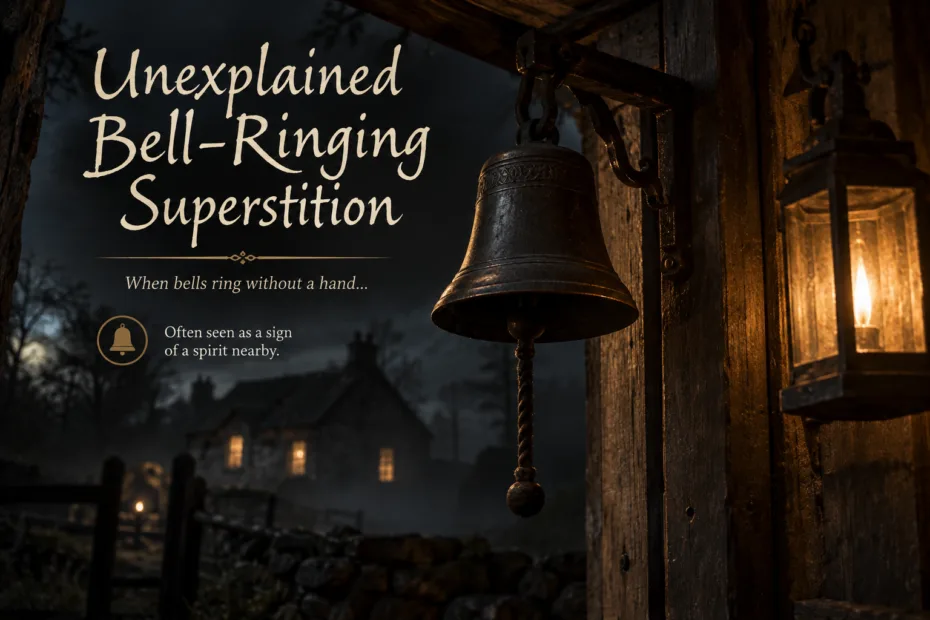
In recorded folk belief, a bell heard ringing without an identifiable cause could be interpreted as a warning of an approaching death. The unexplained nature of the sound was the part that turned an ordinary bell into an omen.
When an Unexplained Bell Became an Omen
A clear example appears in Fanny D. Bergen’s 1896 collection Current Superstitions. A belief recorded from Southern Ohio held that the unexplained ringing of a bell foretold death. The record does not require a certain number of rings, a particular hour, or a named person. Its defining condition is much simpler: a bell is heard, yet there is no ordinary reason for it to be ringing.
Similar ideas were recorded elsewhere in English-language folklore. Shropshire Folk-Lore, published in 1883 from material collected by Georgina F. Jackson and edited by Charlotte S. Burne, describes the belief that a bell ringing by itself could foretell a death. The collection also preserves an account in which unexplained household bell-ringing caused anxiety because an earlier occurrence was remembered as having been followed by a death.
The omen was not simply that a bell rang. Bells rang routinely for practical and ceremonial reasons. The troubling case was a bell that appeared to ring without a known person, signal, or expected event causing it.
The Sound Could Matter Even Without a Visible Bell
Some older British folklore records broaden the motif from a visibly self-ringing bell to the unexplained sound of bells. Collections dealing with the northern counties of England and the Border region include bells heard at night among traditional signs associated with approaching death.
This does not mean every story about distant or mysterious bells carried the same meaning. Folklore also contains phantom bells connected with lost churches, submerged places, particular feast days, and local legends. Those traditions can involve unexplained ringing without treating it as a death omen.
For the death-related superstition, the important pattern is the combination of unexpected sound and lack of an ordinary explanation.
Why Bell-Ringing Could Acquire a Death Meaning
Bells already had a close practical association with death in many Christian communities. A passing bell could be rung when someone was dying, while a death knell announced that a death had occurred. Funeral tolling also marked burial and mourning.
Because listeners were accustomed to hearing certain bell patterns around death, an apparently unbidden bell could be interpreted through that familiar association. Folklore changed the order of events: instead of people ringing a bell because someone had died, the unexplained bell was understood as appearing before the death became known.
A person deliberately rings the bell to announce dying, death, mourning, or a funeral.
The bell or bell-like sound seems to occur without an expected cause and is interpreted as preceding a death.
It Is Different from the “Death-Bell” Heard in the Ear
A related superstition uses the same bell imagery but describes a different experience. Nineteenth-century North American collections record cases in which ringing in the ear was called a death-bell and was interpreted as a warning that news of a death would arrive.
That belief concerns an apparent ringing sensation heard in the ear. The unexplained bell-ringing superstition instead concerns a bell, household bell, church bell, or bell-like sound perceived as coming from the surroundings. The two traditions share an association between ringing and death, but they should not be treated as identical beliefs.
The Omen Depends on the Absence of an Explanation
A scheduled church service, funeral toll, clock mechanism, doorbell, servant bell, or someone deliberately pulling a bell rope would not fit the recorded form of the superstition. The belief begins when listeners cannot account for the ringing through the normal use of the bell.
Historical folklore collections record the interpretation rather than proof that unexplained ringing predicted later events. What they preserve is a recurring idea: a familiar sound associated with announcing death could itself become a warning when it seemed to occur before anyone had reason to ring it.
United States
A bell heard ringing without an identifiable cause is interpreted as a warning of death.