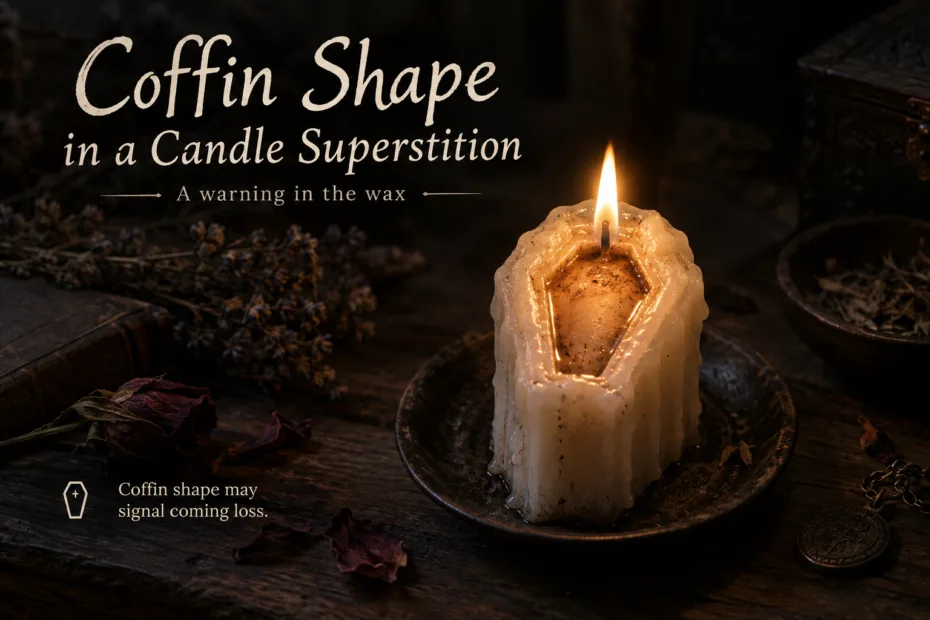
The superstition known as a coffin in a candle treats an unusual formation on a burning candle as an omen of death. A late nineteenth-century American folklore record places the belief in Boston, Massachusetts. The historical wording can be misleading, however: the “coffin” was not necessarily a miniature coffin formed from a pool of melted wax.
What the “Coffin” in the Candle Was
An 1889 record in The Journal of American Folklore gives a useful explanation of the object being observed. The informant understood the “coffin” as a black cinder that developed on the burning candle. It could appear near the main flame, sometimes producing a small separate flame of its own.
Recorded Form of the Omen
- Object observed: a dark, charred formation on the candle
- Traditional name: a “coffin”
- Meaning: a token or warning of death
- Recorded locality: Boston, Massachusetts
This detail matters because modern descriptions sometimes turn the belief into a simple case of coffin-shaped melted wax. The surviving American record points instead to a formation associated with the candle’s burning wick or charred material.
What the Coffin Shape Was Believed to Mean
The interpretation was direct: seeing the formation was regarded as a death omen. Fanny D. Bergen’s 1896 collection Current Superstitions records the Boston belief under its chapter on death omens and states that seeing a coffin in the candle was a token of death.
The entry does not identify a fixed person who was expected to die. It also gives no set interval such as a day, week, or year. The recorded belief therefore supports the general idea of approaching death, but more detailed claims about exactly whose death was predicted or when it would occur go beyond this particular source.
Nothing in the Boston entry describes a ceremony for deliberately producing the sign. Within the collection it appears as an unexpected household omen: an ordinary candle develops an unusual feature, and that feature receives a traditional interpretation.
The Nineteenth-Century Folklore Record
A version appears in The Journal of American Folklore in a collection of death omens. The associated explanation identifies the candle “coffin” with a black cinder forming near the flame.
Fanny D. Bergen includes the belief in Current Superstitions: Collected from the Oral Tradition of English Speaking Folk, published for the American Folk-Lore Society. The locality is given as Boston, Massachusetts.
Bergen’s collection was assembled from oral traditions, personal recollections, and material supplied by correspondents. The entry therefore documents a belief known to an informant or community rather than establishing that every household in Boston shared it.
Coffins and Winding-Sheets in Candle Folklore
The coffin was not the only death-related form people identified in burning candles. Immediately after the Boston entry, Bergen’s collection records a Virginia belief in seeing a “winding-sheet” in the candle, with the same association with death.
Older British folklore preserves another related form. When melted tallow or wax ran down a candle, cooled, and curled back toward it, the loop could be described as the “handle of a coffin.” Some West of England accounts interpreted the direction of this projecting formation as indicating the person believed to be threatened by death.
Coffin in the Candle
A dark cinder or formation associated with the burning candle, recorded in Boston as a death token.
Coffin Handle
A loop or curl produced by guttering candle grease in British folklore, also interpreted as a death sign.
These records share coffin and burial imagery, but they should not be treated as one identical practice. Different collectors described different physical formations and different local interpretations.
Historical Omen and Modern Wax Reading Are Not the Same Record
A coffin-like shape in a pool of cooled candle wax can also appear in modern systems of candle interpretation. That is not enough to identify it automatically with the historical Boston superstition.
The older record is more specific: its “coffin” was associated with a blackened formation on a burning candle, and its recorded meaning was death. Treating every coffin-shaped wax puddle as the same nineteenth-century belief would merge separate strands of candle lore.
The surviving sources document the superstition as historical folklore. They do not establish how widely the belief is followed today, and the omen itself should be understood as a traditional interpretation rather than a prediction with demonstrated causal force.
United States
Seeing a coffin-like form in a burning candle is interpreted as a token of death.