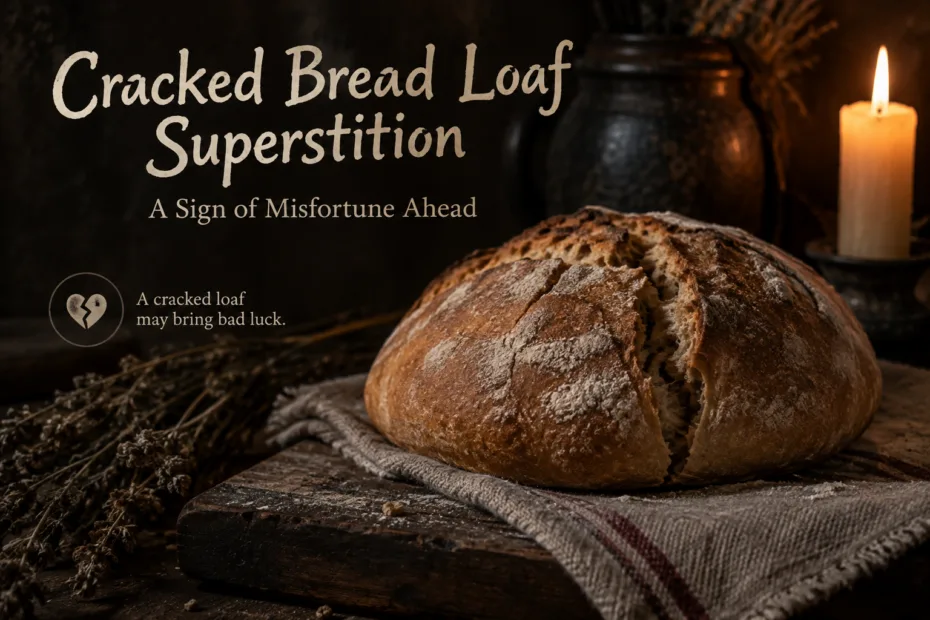
In several documented folk traditions, a loaf that cracked or split while baking was read as an omen of death. Depending on the recorded version, the expected death concerned someone in the household, a relative, or a friend.
What the Crack Was Believed to Foretell
The clearest recorded form concerns a crack appearing across the top of a loaf during baking. Fanny D. Bergen’s 1896 collection Current Superstitions preserves one belief from New Jersey and Ohio in which such a crack foretold death. A closely related entry, collected from several localities, associated cracks on top of a loaf with the death of a friend.
The wording matters. The omen was attached to something that happened to the bread as it baked, rather than to ordinary slicing or breaking at the table. The surviving entries do not give a fixed period in which the predicted death was expected to occur.
The Pennsylvania German Version
Edwin Miller Fogel recorded a closely matching belief in Beliefs and Superstitions of the Pennsylvania Germans, published in 1915. In one entry, a loaf whose crust cracked across the middle while baking was believed to foretell a death in the family.
Fogel also preserved a related form in which the crust separating from the loaf during baking carried the same meaning. These records show that the exact appearance could vary: the important feature was an unexpected change in the loaf or its crust while it was in the oven.
Recorded Form of the Omen
- The crack or separation appeared during baking.
- The affected area could be described as the top, middle, or crust of the loaf.
- The predicted event was commonly a death within the family or social circle.
- The historical sayings do not identify the crack as causing the event; it was treated as a warning sign.
An Earlier German Folklore Record
The motif was already present in 19th-century folklore scholarship. Edwin Sidney Hartland’s 1895 The Legend of Perseus mentions a tradition from Rauen in northern Germany in which a crack in a newly baked loaf was taken to mean that a member of the family would die.
Hartland discussed the example alongside other forms of divination involving bread and baking. This places the cracked-loaf belief within a broader pattern in which the condition of food emerging from the oven could be interpreted as an omen concerning members of a household. The record does not establish that every later cracked-bread superstition descended directly from this particular tradition.
What Counted as a Cracked Loaf
During Baking
The documented sayings focus on a split that appeared as the loaf baked or was newly baked.
Across the Crust
Records describe cracks across the top or middle, and in one version the crust pulling away from the loaf.
A Death Omen
The person concerned might be described as a family member or friend rather than the baker specifically.
The historical wording does not treat every damaged loaf in the same way. It does not mention deliberate scoring, cutting a finished loaf, tearing bread by hand, or a loaf breaking after it had been served. The canonical superstition is narrower: an unexpected crack appearing in a loaf through the baking process was read as an omen of death.
United States
A loaf that cracks across the top while baking is interpreted as a death omen.