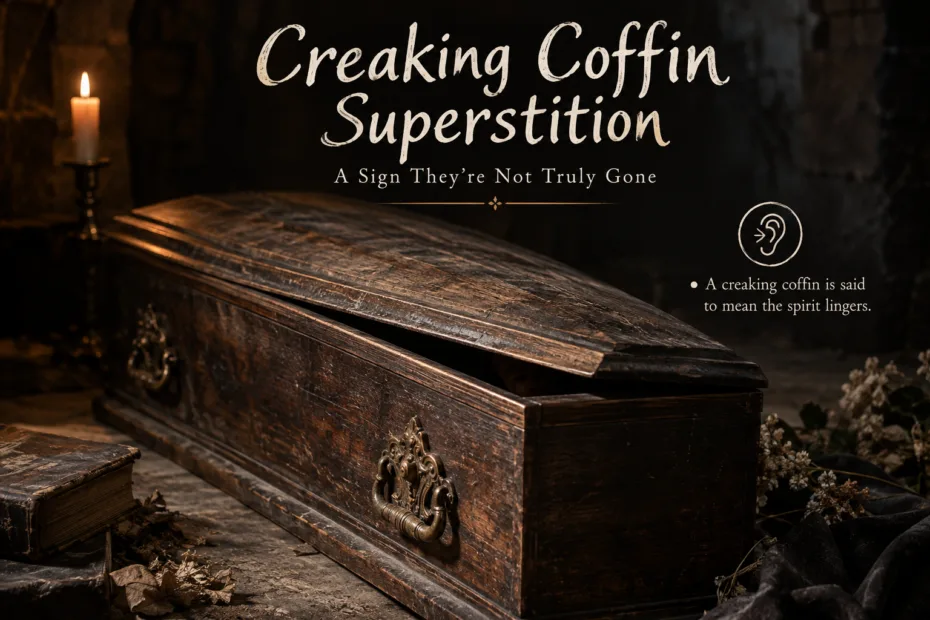
A coffin that creaked in a carpenter’s shop was once recorded as an omen that another coffin order would soon arrive. The surviving record is narrow and local: it was documented in Newark, New Jersey, and Virginia rather than described as a universal funeral belief.
What the Creaking Coffin Was Said to Foretell
The recorded superstition links an unexplained creak from a coffin with another coffin being needed soon. The prediction concerns the carpenter receiving another order, which indirectly implies another death.
Recorded Form
“If a coffin creaks in a carpenter’s shop, another order soon follows.” The belief was listed for Newark, New Jersey, and Virginia in Fanny D. Bergen’s 1896 collection Current Superstitions.
This detail matters because the belief is sometimes easy to reinterpret as a story about noises coming from a buried coffin or a corpse moving inside one. The historical entry describes neither. Its setting is specifically a carpenter’s shop, where the coffin was present before burial.
A Workshop Omen Rather Than a Funeral Ritual
The superstition belongs to a group of death omens in which an ordinary sound or event was treated as advance notice of another death. In this case, the wording follows the carpenter’s occupation: the predicted event is another order for a coffin.
The same nineteenth-century collection places the belief beside another workshop omen. An unexplained light appearing in a carpenter’s shop was said in one Cape Breton record to mean that the carpenter would soon have to make a coffin. Both beliefs turn an unusual occurrence in a workplace associated with coffin-making into a prediction of future work.
No accompanying action is given for stopping, reversing, or protecting against the omen. The recorded belief functions as a prediction, not as a ritual instruction.
Why a Creak Could Carry an Ominous Meaning
Creaking sounds appear more broadly in older death-omen traditions, although those traditions should not be treated as identical to the coffin belief. Folklore collections from Britain and North America record unexplained creaking or cracking from furniture and household woodwork as possible signs of illness, misfortune, or death.
The coffin example narrows that wider sound-omen pattern to an object already associated with death. Instead of an unexplained creak somewhere in a house, the sound comes from the coffin itself, while the expected consequence is another coffin order.
The surviving record does not explain why the coffin was thought to creak. It does not identify a spirit, the deceased, or any supernatural agent as the source of the sound. Adding such an explanation would go beyond the documented form of the superstition.
How Narrow the Historical Evidence Is
Bergen’s Current Superstitions was published for the American Folk-Lore Society in 1896 and assembled beliefs gathered from oral tradition. The coffin-creaking entry appears in its chapter on death omens and names only Newark, New Jersey, and Virginia for this particular form.
That geographic note supports describing the superstition as a recorded American folk belief, but not as something once believed everywhere in the United States. It also does not establish how common the belief was within either Newark or Virginia.
The source gives no named originator, first occurrence, exact age of the belief, or evidence that it remains actively observed today. Its value is as a preserved example of nineteenth-century oral superstition in which a strange sound from a coffin was interpreted as a warning that another coffin would soon be required.
United States
A coffin creaking in a carpenter’s shop is interpreted as a sign that another coffin order, and therefore another death, will soon follow.