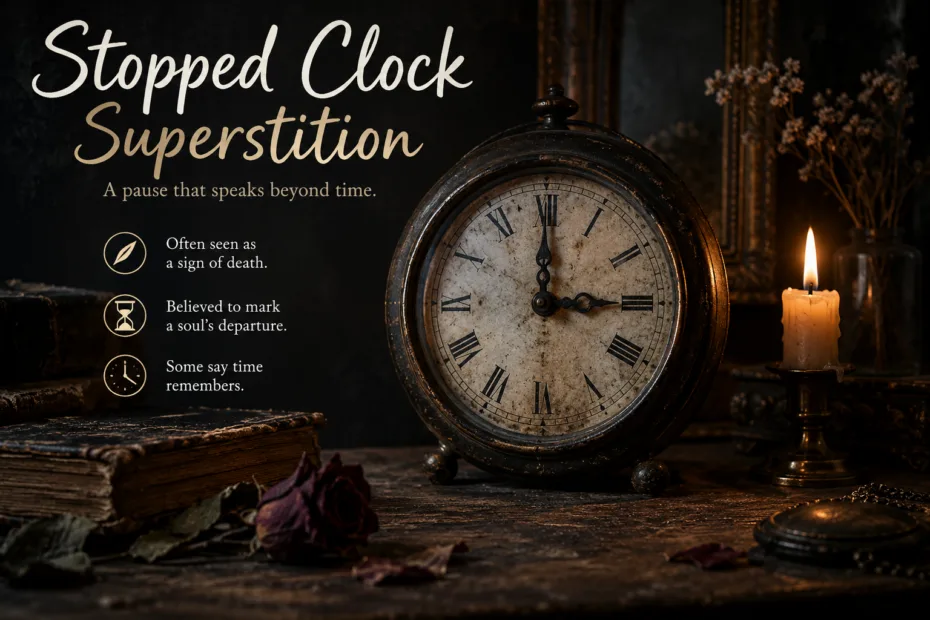
In recorded folklore, a clock that stops unexpectedly can be interpreted as an omen of death, especially when its hands appear to preserve the hour at which someone died. A closely related mourning custom involved stopping household clocks deliberately after a death.
What Does a Stopped Clock Mean in Superstition?
The strongest historical association is with death and the time of death. In some traditions, an unexplained stopped clock was treated as a warning that someone was dying or would soon die. Stories could become more striking when the clock stopped at the same hour as a death elsewhere.
The belief does not have one fixed rule. Folklore records distinguish between a clock stopping unexpectedly, a clock running down when it normally would not, and a clock being deliberately stopped by members of a household. All could become associated with death, but they represented different actions and interpretations.
An Omen and a Mourning Custom Are Not the Same Thing
An apparently unexplained stop could be interpreted as a death omen or as a mysterious sign connected with a death occurring at that time.
In documented funeral customs, relatives deliberately stopped clocks after a person died. The stopped hands could preserve the hour of death and mark the altered state of the household during the wake or mourning period.
These two traditions overlap so closely that later retellings can merge them. A custom in which people intentionally stopped a clock can become a story in which the clock itself somehow recognized the death.
Stopped Clocks as Death Warnings
The connection between an unexpectedly stopped clock and impending death was already being recorded in nineteenth-century British folklore. Shropshire Folk-Lore, published in 1883 from collections associated with Georgina Frederica Jackson and edited by Charlotte Sophia Burne, includes a story from Welshampton in which a clock repeatedly stopped during a man’s illness at an hour that was later identified with his death.
The same collection records another form of the omen: a clock running itself down. In one account, a boy feared that his ill aunt would die because the household clock had run down during the night. The recorded explanation referred to earlier deaths that had also been associated with a clock unexpectedly running down.
Some stories did not concern a clock that stopped only once. A clock repeatedly stopping at a particular hour could acquire meaning when a later death occurred at that same hour.
When the Hands Mark the Time of Death
A stopped clock becomes particularly meaningful in death folklore when its hands appear to preserve the exact moment of a person’s passing. This image also connects the supernatural omen with the deliberate household custom of stopping a clock once a death had occurred.
Irish folklore collections preserve examples in which household clocks were intentionally stopped at the hour of death. A County Louth account recorded in the Schools’ Collection describes all the clocks in the house being stopped to mark the hour at which the person died. They were not wound again until after the funeral.
Other Irish records describe similar practices without assigning exactly the same duration. In some places the clocks remained stopped while the body was in the house; elsewhere the practice is simply recorded as part of what happened immediately after death. The variation shows that the custom was transmitted locally rather than governed by one universal rule.
Why Were Clocks Deliberately Stopped After a Death?
One explanation preserved in Irish material is practical: the stopped clock displayed the hour at which the person died. Anyone entering the house could see the time without needing to ask the bereaved family.
The action also belonged to a wider group of household practices surrounding a death. Folklore records place stopped clocks beside such customs as covering mirrors, opening doors or windows, maintaining a vigil, and temporarily changing ordinary household routines.
The meanings assigned to these practices were not identical everywhere. Some explanations focused on the deceased, some on the household, and others simply described stopping the clock as the customary thing to do when a person died. It is therefore safer to treat the stopped clock as a family of related death customs rather than attach one explanation to every recorded example.
How “Grandfather’s Clock” Reinforced the Belief
Henry Clay Work’s song Grandfather’s Clock, published in 1876, gave the stopped-clock motif a memorable popular form. The clock in the song accompanies its owner throughout his life and stops permanently when the old man dies.
The song did not invent every association between clocks and death. Folklore collections contain related beliefs and customs of their own. Its popularity, however, placed the image of a clock stopping when its owner dies into a widely circulated nineteenth-century story.
The connection became so familiar that the clock and the person’s lifetime appear almost synchronized: when one life ends, the other mechanism ceases to measure time.
The Silence of the Clock in the Wake House
Some Irish records emphasize not only the stopped hands but also the silence created by stopping the clocks. A 1938 folklore manuscript states that when a person died in a house, the clocks should be stopped and everything kept silent.
This gives the custom a different character from the spontaneous omen. The clock is no longer warning the household about a future event. The death has already occurred, and the clock becomes part of the household response to it.
Accounts from different districts also record all clocks and watches being stopped in a wake or corpse house. The practice could therefore concern more than one prominent mantel or wall clock; in some recorded traditions, ordinary timekeeping throughout the house was temporarily suspended.
Why the Exact Hour Became So Important
Much of the superstition depends on coincidence between clock time and the moment of death. A clock that merely stops can be an inconvenience. A clock discovered stopped at the precise hour associated with a death creates a story with a memorable correspondence between the person and the object.
This pattern appears in both forms of the tradition. In the mourning custom, people deliberately fixed the hands at the known hour of death. In omen stories, the striking detail is that the clock supposedly reached that hour without anyone intentionally stopping it.
That distinction explains why stopped-clock folklore can contain both an ordinary funeral practice and a supernatural interpretation without the two being interchangeable.
United States
A clock that has long been still and suddenly begins ticking or striking is interpreted as a sign of approaching death or misfortune.