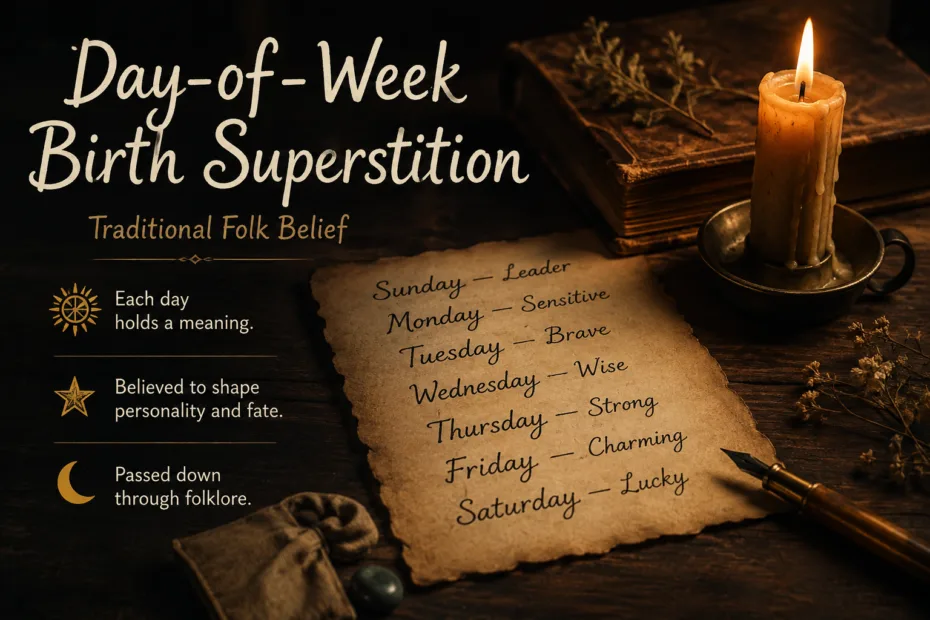
A long-standing folk belief assigns a child’s character, fortune, or future to the day of the week on which the child was born. The best-known English expression of the idea survives in the traditional “Monday’s Child” rhyme, although historical versions did not always agree on what each day predicted.
What the Day of Birth Was Said to Predict
In English-language tradition, weekday birth lore turned the seven-day calendar into a simple system of character and fortune telling. Each day was associated with a different quality, ranging from appearance and temperament to work, travel, happiness, or hardship.
| Day of Birth | Common Association | Traditional Interpretation |
|---|---|---|
| Monday | Fair appearance | The Monday-born child was commonly described in favorable terms connected with appearance. |
| Tuesday | Grace | Tuesday was associated with gracefulness or favorable personal qualities. |
| Wednesday | Woe | One of the most memorable versions portrays Wednesday birth as connected with sorrow or difficulty. |
| Thursday | A long way to go | The wording is less specific than the other lines and has been interpreted in terms of journeys, ambition, or a long path through life. |
| Friday | Love and generosity | Many familiar versions give Friday-born children affectionate and giving qualities. |
| Saturday | Hard work | Saturday birth became associated with earning one’s living through sustained work. |
| Sunday | Good fortune | Later widely circulated versions usually give the Sabbath-born child especially favorable qualities. |
These associations should not be treated as a single fixed code. Folk rhymes circulated orally, and collectors recorded different wording, different final lines, and sometimes substantially different predictions.
The Belief Predates the Familiar Nursery Rhyme
The idea of judging fortune from the weekday of birth was known in England well before the best-known printed versions of “Monday’s Child.” Elizabethan writer Thomas Nashe recalled folk practices in which older people told young people what sort of luck they would have according to the day of the week on which they had been born.
By the nineteenth century, the idea appeared clearly in collections of traditional rhymes. James Orchard Halliwell’s Popular Rhymes and Nursery Tales, published in 1849, placed the verse under the heading “Days of Birth.” Its sequence gives Monday through Saturday familiar qualities but ends with a child born on Christmas Day rather than a Sunday-born child.
The Halliwell form makes Christmas birth exceptionally fortunate. Other versions replace Christmas Day with the Sabbath, usually understood as Sunday. The difference is evidence that the rhyme changed as it circulated rather than preserving one universally accepted set of predictions.
Why Sunday Often Receives Special Treatment
Sunday occupies an unusually favorable position in many later forms of the rhyme. Its status as the Christian Sabbath made it culturally different from an ordinary weekday, allowing ideas about sacred time to overlap with birth folklore.
Other traditions from the British Isles also attached special meanings to Sunday births without necessarily following the “Monday’s Child” sequence. Irish folklore collections, for example, record beliefs in which being born on a Sunday altered supernatural qualities otherwise attributed to certain children. Separate beliefs could also distinguish particular religious Sundays, showing that the exact calendar occasion sometimes mattered as much as the weekday itself.
This helps explain why “born on Sunday” folklore should not automatically be reduced to one nursery-rhyme line. Weekday divination and beliefs about births on sacred days could overlap while remaining separate traditions.
The Meanings Were Never Universal
The familiar English rhyme can give the impression that every weekday possessed one stable traditional meaning. Historical material shows a much less orderly picture. Regional versions could transfer favorable or unfavorable qualities from one day to another, replace Sunday with Christmas, or supply predictions that bear little resemblance to the nursery version now commonly remembered.
Uses short, memorable descriptions and a repeating weekday structure suitable for oral transmission and children’s recitation.
Could assign luck, temperament, longevity, work, morality, or other predicted qualities to birth days, with meanings varying between places and collections.
The rhyme is therefore better understood as one particularly durable expression of weekday-birth divination rather than a complete catalogue of all beliefs about being born on Monday, Tuesday, or another day.
Weekday Birth Traditions Outside the English Rhyme
Associating a person with the weekday of birth is not unique to English folklore, but similar systems should not automatically be described as versions of “Monday’s Child.” They can belong to distinct naming, religious, or astrological traditions with their own histories.
Akan Day Names and Character Associations
Among Akan communities, a person’s day of birth traditionally plays a direct role in personal naming. Male and female day names identify the weekday on which a person was born, and scholarly descriptions of the naming system also document character associations attached to particular days.
For example, some recorded Akan interpretations associate Monday birth with peacefulness and calmness, while other weekdays have their own traditional attributes. This system operates as part of Akan naming and cultural identity and should not be treated simply as an African equivalent of an English nursery rhyme.
Myanmar Weekday Astrology
Myanmar provides another distinct example. Traditional astrology assigns significance to the weekday of birth, and Wednesday is divided into two astrological periods, producing eight weekday stations. Birth-day associations can be linked with planetary symbols, directions, animals, naming practices, and devotional customs.
At pagodas, a person’s birth day may determine the planetary station at which particular acts of merit are performed. Here the weekday functions within a larger astrological and religious framework rather than as a short prediction of personality alone.
Folklore Does Not Establish Personality by Birth Day
The traditional predictions are cultural beliefs rather than demonstrated rules of human development. Research testing the “Monday’s Child” idea has found no evidence that being born on a particular weekday predicts the personality or physical characteristics assigned by the rhyme.
Descriptions such as the sorrowful Wednesday child or hardworking Saturday child document how birth was interpreted in folklore. They do not provide a reliable method for predicting an individual’s temperament, appearance, success, or future.
The continuing familiarity of the rhyme is therefore evidence of the durability of weekday-birth folklore, not evidence that the weekday itself determines a child’s character.
United States
A child’s character or future is associated with the weekday on which the child is born.