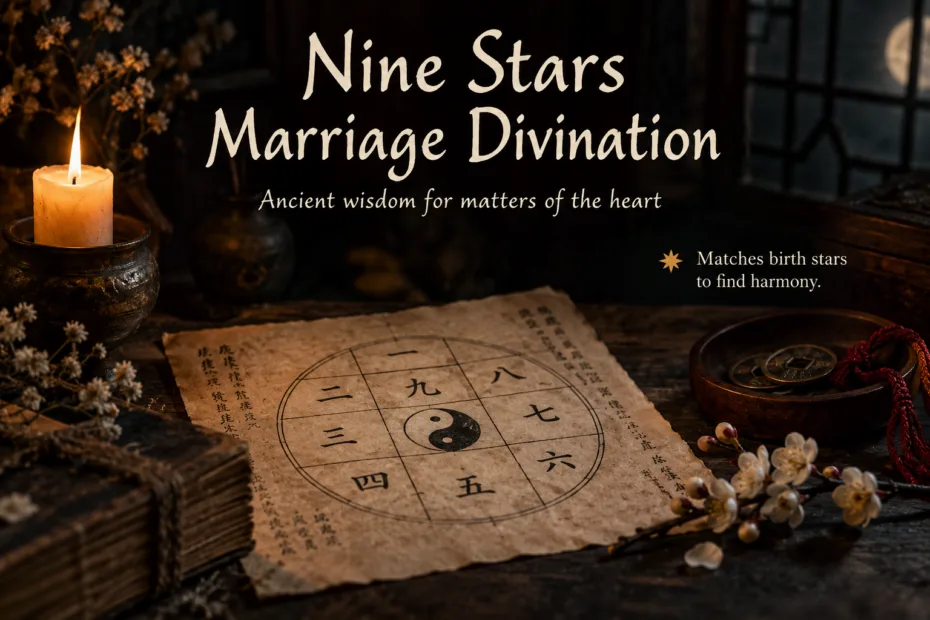
Nine Stars marriage divination interprets the birth stars of two people through a nine-part system linked with the Five Elements. The resulting relationship was traditionally read as supportive, similar, or potentially conflicting rather than as a literal observation of stars in the sky.
The Nine Stars Used in Marriage Divination
The name Nine Stars refers to nine symbolic categories used in East Asian calendrical and divinatory traditions. They are commonly known in Japanese Nine Star Ki, or Kyūsei Kigaku, as One White Water, Two Black Earth, Three Jade Wood, Four Green Wood, Five Yellow Earth, Six White Metal, Seven Red Metal, Eight White Earth, and Nine Purple Fire.
These “stars” are not nine astronomical bodies whose positions are observed for a marriage. Each is a numbered category associated with a phase or element, direction, and position within a nine-part arrangement. A person’s birth date is used to determine which category applies.
| Nine Star | Traditional Name | Five Element |
|---|---|---|
| 1 | One White Water | Water |
| 2 | Two Black Earth | Earth |
| 3 | Three Jade Wood | Wood |
| 4 | Four Green Wood | Wood |
| 5 | Five Yellow Earth | Earth |
| 6 | Six White Metal | Metal |
| 7 | Seven Red Metal | Metal |
| 8 | Eight White Earth | Earth |
| 9 | Nine Purple Fire | Fire |
How Two Birth Stars Were Compared
A basic marriage reading begins by identifying the principal birth star of each person. In Japanese terminology this is often called the honmeisei, or main life star. More elaborate readings can also consider a star derived from the birth month and other positions in the Nine Star chart.
The pair is then compared through the Five Elements relationship: Water, Wood, Fire, Earth, and Metal. Since several of the nine stars share the same element, the first question is not simply whether two star numbers match. The relationship between their elements also matters.
Within the belief system, a generating relationship could be interpreted as one person supporting or nourishing the other. Two stars belonging to the same element could be treated as sharing similar qualities. A controlling relationship could be read as producing more tension or requiring greater adjustment.
Supportive, Similar, and Opposing Matches
One Element Supports Another
Wood feeds Fire, Fire produces Earth, Earth produces Metal, Metal is associated with producing Water, and Water nourishes Wood. Marriage interpretations can treat these pairings as supportive relationships, although the direction of support may also be considered.
Shared Elemental Character
Some different stars belong to the same element. Three and Four are both Wood; Two, Five, and Eight are Earth; Six and Seven are Metal. Such pairings may be interpreted through similarity rather than through a generating cycle.
A More Tense Combination
Traditional Five Element theory also contains a controlling cycle: Water controls Fire, Fire controls Metal, Metal controls Wood, Wood controls Earth, and Earth controls Water. Marriage divination can use these relationships to describe combinations believed to contain more friction.
A controlling combination did not necessarily function as an automatic prohibition on marriage. Interpretive traditions can describe difficult combinations as relationships in which differences, competing tendencies, or unequal support require more attention. Published Nine Star relationship systems also contain differing terminology and levels of detail, so there is no single universal marriage table shared by every practitioner.
Why the Birth Date Can Produce Unexpected Results
Nine Star calculations do not always divide years at January 1. Systems derived from the traditional East Asian solar calendar normally place the change of the annual cycle in early February, around the beginning-of-spring seasonal boundary. Someone born in January or the first days of February may therefore belong to the preceding annual star rather than the one suggested by the Gregorian year alone.
A marriage comparison based only on two Gregorian birth years can give the wrong Nine Star categories when either birth falls near the early-February transition. The calendrical method used by the particular tradition must be applied consistently.
Calculation methods can also differ between lineages. Some modern Nine Star Ki systems use the same descending annual sequence for everyone, while related methods may calculate particular charts differently according to sex. This is one reason two books or calculators can occasionally assign different values to the same person.
Marriage Divination Within Nine Star Ki
The Nine Star material now widely known as Nine Star Ki combines older Chinese cosmological ideas, the Lo Shu nine-part square, Five Element relationships, calendrical cycles, and direction lore. Its modern Japanese form was systematized in the early twentieth century by Shinjiro Sonoda and became associated with readings concerning character, timing, directions, relationships, and marriage.
Marriage readings use the same symbolic vocabulary rather than a separate set of nine marriage deities. The partners’ stars are identified first, then their elemental and chart relationships are interpreted. Some methods remain close to the main birth stars, while others add monthly stars or additional chart positions to describe the pair in more detail.
This makes Nine Stars marriage divination a compatibility method rather than a single ritual. It may appear as a written chart, an almanac calculation, a practitioner consultation, or a modern compatibility table. The shared idea is that the birth classifications of two people can be compared through the ordered relationships assigned to the Nine Stars.
What the Marriage Reading Was Believed to Indicate
Depending on the method, the interpretation could address harmony between temperaments, which partner was believed to support the other, areas of possible disagreement, or the general character attributed to the union. More elaborate systems could combine relationship compatibility with favorable or unfavorable periods and directions.
The result belonged to a divinatory model of marriage. A favorable star relationship represented auspicious compatibility within that model; an unfavorable relationship represented a symbolic warning or tension. It did not establish whether two people would actually have a successful marriage.
For that reason, historical or cultural descriptions of the practice distinguish its traditional interpretations from observable causes of relationship success. The Nine Stars describe how a marriage was classified within the belief system, not a proven mechanism that determines affection, behavior, or marital outcomes.
United States
After viewing the new moon, nine stars are counted and an object found beneath the right foot is placed under the pillow to prompt a dream of a future husband.