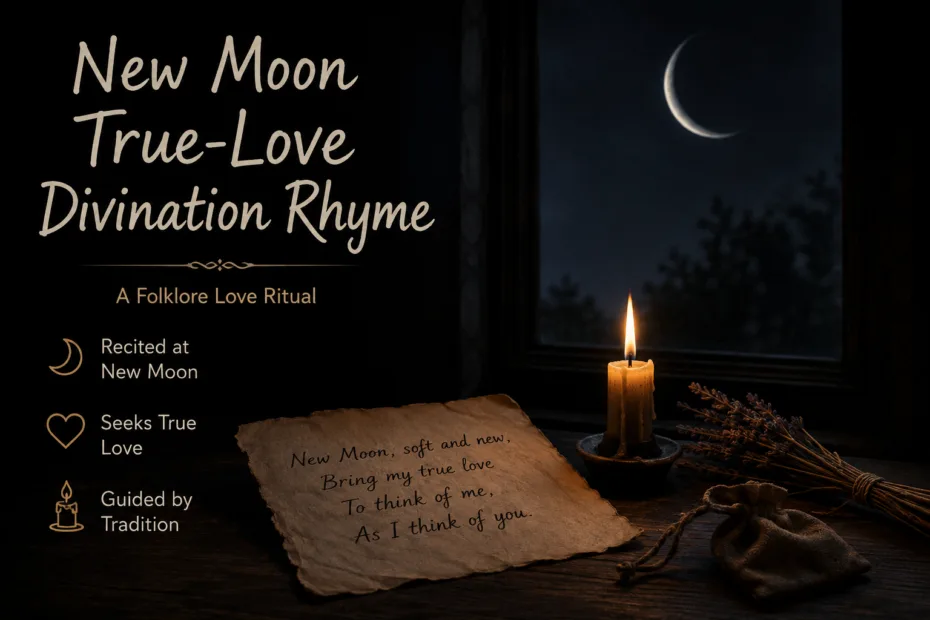
The “new moon, true moon” rhyme belongs to a family of love-divination verses recorded in nineteenth-century English-speaking folklore. The words were spoken when the new moon was first noticed, with a dream, a sound, or another small sign expected to reveal something about a future spouse.
A Rhyme with No Single Fixed Text
Historical records do not preserve one authoritative version of the new-moon true-love rhyme. Instead, they show a group of closely related verses built around the same idea: addressing the newly seen moon and asking it to disclose a future romantic partner.
An 1851 contribution on Devonshire superstitions in Notes and Queries describes a person going to a stile after first seeing the new moon following Midsummer. The moon was addressed with a verse asking that the speaker’s true love be revealed that night.
By 1896, Fanny D. Bergen’s Current Superstitions recorded several related forms from English-speaking communities in North America. Some asked for the future partner’s appearance, some sought a dream, and another interpreted sounds heard after the rhyme.
Documented Form
A Tennessee version begins:
“New moon, true moon, true and bright,
If I have a lover let me dream of him to-night.”
The remaining lines assign different meanings to sounds heard afterward.
What the Moon Was Asked to Reveal
The surviving versions do not all ask the same question. Several kinds of romantic information appear in the records.
Identity
Some forms simply ask who the speaker’s “true love” or future spouse will be.
Appearance
Recorded verses from Ohio and Prince Edward Island ask about features such as hair and the clothes the future partner will wear.
Marriage
Other forms ask when marriage will occur, whether the partner will come from near or far, or whether marriage is expected at all.
Dreams
Several versions expect the answer to appear during sleep rather than through an immediate waking sign.
The First Sight of the New Moon Mattered
The timing in these records is unusually consistent. The rite is associated with first seeing the new moon, although the exact occasion varies.
The 1851 Devonshire account specifies the first new moon after Midsummer. Other nineteenth-century records refer simply to the first appearance of a new moon, while some related customs were attached to the first new moon of the year.
This means the folk practice was centered on the observer’s encounter with the newly visible moon rather than on a precisely calculated lunar moment. The act of noticing it supplied the occasion for the rhyme.
Dreaming of a Future Partner
Dream divination is one of the clearest recurring features. In a Prince Edward Island version collected by Bergen, the person held a small object while saying the rhyme. The object could be something ordinary, such as a handkerchief or pebble. It was then placed under the pillow, with the expectation that the future husband would appear in a dream.
A version recorded from Middleborough, Massachusetts, is even more direct: the speaker asks that the person they are to marry smile on them in their sleep.
English records show the same association between the new moon and a revelatory dream. An 1880 folklore collection describes a Berkshire custom in which young women addressed the first appearance of the new moon and expected to see their future husbands before morning.
Historical Wording
Many surviving collectors describe these practices in terms of young women seeking information about a future husband. That reflects the wording and social setting of the recorded examples rather than proving that every form of the belief followed the same gender pattern.
From an English Record to North American Variants
1851
Notes and Queries prints a Devonshire belief involving the first new moon after Midsummer, a stile, and a verse asking the moon to reveal the speaker’s true love that night.
1880
T. F. Thiselton-Dyer’s English Folk-Lore records several moon-related love divinations, including forms associated with Devonshire and Berkshire.
1896
Current Superstitions, edited by Fanny D. Bergen, preserves several new-moon love-divination verses from places including Ohio, Prince Edward Island, Massachusetts, and Tennessee.
These dates establish that closely related forms were in print by the mid-nineteenth century and were later collected from oral tradition in several English-speaking communities. They do not establish when the rhyme was first created.
The Sound-Omen Version
The Tennessee form recorded in 1896 combines the rhyme with a small sequence of actions and audible omens. After seeing the new moon over the right shoulder, the person was instructed to take three steps backward and recite the verse.
Instead of relying only on a dream, the rhyme assigned meanings to sounds heard afterward:
- A bird cry indicated marriage far away.
- A cow lowing indicated marriage nearby.
- A hammer knocking indicated that the speaker would not marry.
This version shows how far the rhyme could move beyond a simple request to see a future lover. The new moon remained the point of invocation, but the expected answer could be transferred to ordinary sounds in the surrounding environment.
United States
On first seeing the new moon, a rhyme is recited asking the moon to reveal the future spouse and details about them.