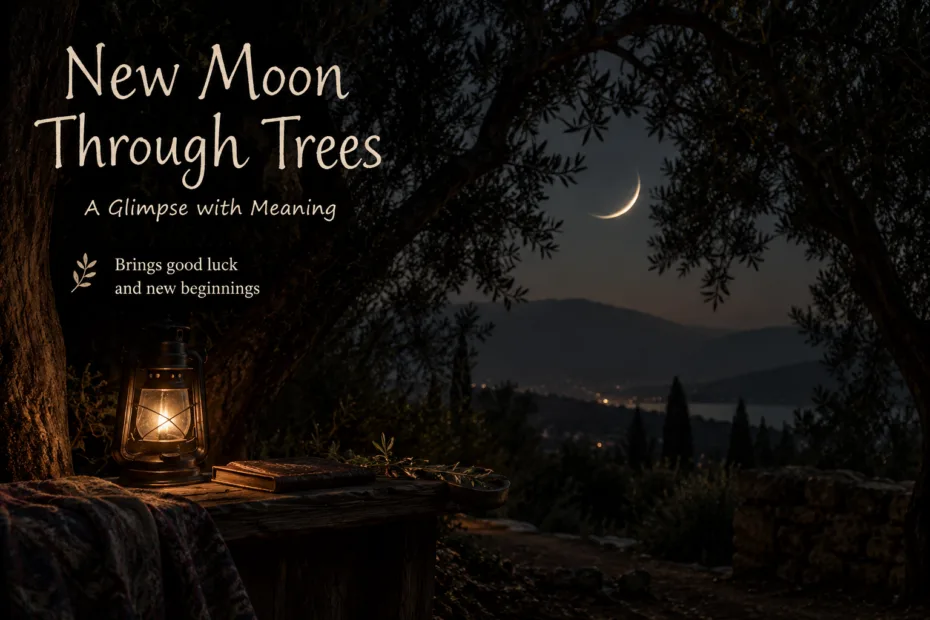
The superstition holds that first seeing a new moon through trees, branches, or brush brings bad luck or trouble for the coming month. Historical records show that the condition of the first sighting matters: an unobstructed view and a moon glimpsed through vegetation could be treated differently.
The First Glimpse of the Moon Matters
The belief is not simply about looking at the Moon while standing near trees. In many recorded versions, the omen depends on how the new moon is first seen.
A person who first notices the crescent between branches, through treetops, or behind brush is said to have an unlucky month ahead. Some versions describe the expected result as general bad luck, while others use the milder idea of trouble lasting until the next new moon.
Recorded Pattern
- The moon must usually be newly visible or seen for the first time during that lunar cycle.
- Trees, branches, brush, or treetops obstruct the view.
- The predicted trouble commonly lasts for the month or until the next new moon.
The wording found in folklore records points to the first visible crescent rather than the exact astronomical instant of new moon, when the Moon is not normally visible from Earth. The event in the superstition is therefore the person’s first encounter with the returning crescent.
A Belief Recorded on Both Sides of the Atlantic
The superstition appears in nineteenth- and twentieth-century folklore records rather than in a single isolated account.
Timothy Harley’s Moon Lore, published in 1885, records a Staffordshire belief that seeing the new moon through trees was unlucky. The emphasis was again on the manner in which the new moon was first observed.
Fanny D. Bergen’s 1896 collection Current Superstitions, based on oral traditions among English-speaking people in North America, gives a closely matching form: seeing the new moon through trees or brush was expected to bring trouble during that month. The collection described this form as generally known in the United States.
An 1890s record in the Journal of American Folk-Lore also connects a new moon seen through clouds or treetops with trouble lasting until the next new moon. Later American folklore archives continued to preserve similar statements, including versions referring specifically to tree branches.
The belief was also recorded in Ireland. Material gathered for the Irish Folklore Commission’s Schools’ Collection in 1937–1939 includes a County Roscommon account stating that seeing the new moon for the first time through trees or glass was a sign of bad luck during that month.
Why the Trees Are Part of the Omen
The surviving records usually preserve the rule without giving an explanation for why branches make the first sighting unlucky. There is therefore no well-supported single origin story that can be attached to the superstition.
What the records do show is a broader distinction between a clear first view and a view made through something else. Trees and brush are only one form of obstruction found in new-moon folklore. Glass, veils, clouds, and other barriers also appear in related traditions.
This makes the trees less important as a particular species or sacred object than as something standing between the observer and the crescent. Historical versions do not normally require a certain tree, number of branches, forest setting, or direction of view.
Bad Luck Usually Lasts One Lunar Cycle
The predicted consequence is generally limited in time. Instead of describing permanent misfortune, several records attach the omen to the month that has just begun.
This boundary fits the way many new-moon beliefs are structured. The first sight of the crescent acts as the opening moment of a new period, and circumstances surrounding that sight are treated as signs for what will happen before the next lunar cycle begins.
Recorded wording ranges from “bad luck” to “trouble,” so the tradition does not consistently predict a specific accident, loss, illness, or other event. More detailed consequences should not be assumed where the historical record gives only a general unlucky period.
Direct Sight and Obstructed Sight
Some closely related records make the contrast especially clear. A moon seen openly could be treated as favorable, while the same crescent seen through treetops or another obstruction could be interpreted as unfavorable.
Clear First View
The crescent is seen directly in the open sky. Some recorded traditions associate a clear view with good fortune.
View Through Trees
The first glimpse comes through branches, brush, or treetops. The recorded omen is usually trouble or bad luck during the lunar month.
This distinction also explains why accidentally noticing the crescent through foliage could matter within the belief. Once that first sight had occurred, simply walking into an open area and looking again would not necessarily change which sight counted as the month’s first encounter with the new moon.
The Tradition as a Folklore Record
The superstition is best understood as a documented rule of lunar omen folklore. Historical collectors recorded people associating the first appearance of the crescent with luck, money, relationships, weather, work, and other expectations for the coming period. Seeing it through trees belongs to that wider family of first-sighting beliefs.
The surviving material supports the existence and transmission of the belief, but it does not establish that an obstructed view of the Moon causes later events. Nor do the records support assigning the custom to one universal culture or claiming that everyone in the places where it was collected shared it.
Its most stable recorded form remains simple: if the new moon is first seen through trees or branches, trouble or bad luck is expected before the next new moon.
United States
First seeing the new moon through trees or brush is interpreted as a sign of trouble during the month.