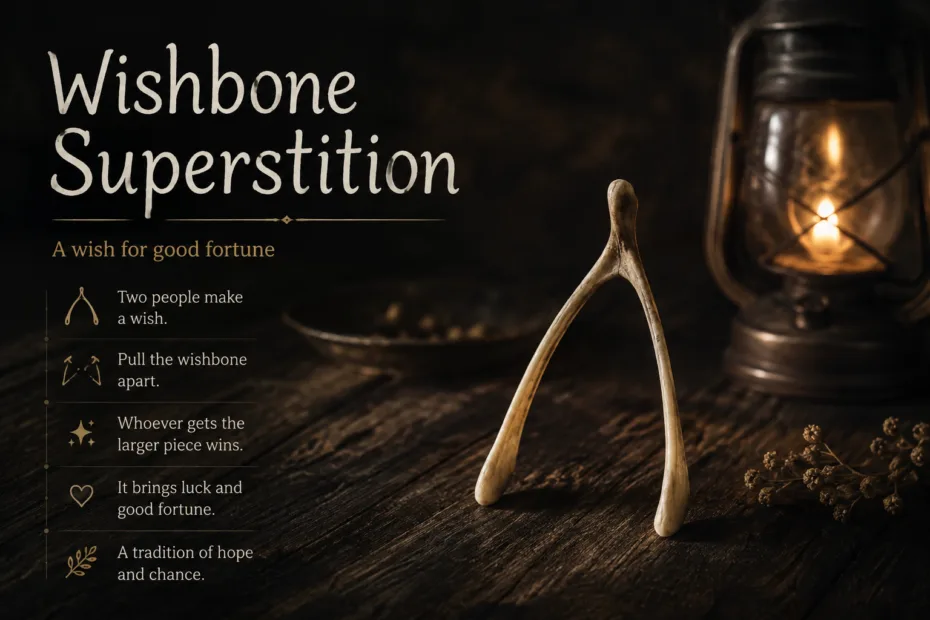
The wishbone superstition turns the forked breast bone of a bird into a small contest of luck. Two people pull opposite sides until the bone breaks, and the person who receives the favored piece is traditionally expected to have a wish fulfilled. Older versions did not always concern wishes; some used the same contest to predict marriage.
What the Wishbone Superstition Says
In the best-known form, two people each hold one branch of a wishbone and make a wish before pulling. When the bone snaps, the person holding the larger piece is considered the winner, and folklore says that person’s wish has the better chance of coming true.
The rule has never been completely uniform. Historical descriptions record places where the shorter piece could be favored instead. Other versions changed the meaning of winning altogether, especially when the custom was used as a form of courtship or marriage fortune-telling rather than simple wish-making.
A Variable Folk Rule
“Larger piece wins” is now the familiar rule, but older records show that local customs could reverse the result or attach a different prediction to the broken pieces.
The Wishbone Was Once Called the Merrythought
The superstition is older than the modern English word wishbone. In Britain, the forked bone was traditionally known as the merrythought. The word is recorded by the end of the sixteenth century, with Merriam-Webster dating its earliest known use to 1598.
Seventeenth-century descriptions show that breaking the merrythought between two people was already a recognized custom. English antiquary John Aubrey recorded the practice among the folk usages he collected in the late seventeenth century.
The traditional explanation for the name connected “merrythought” with the pleasant hopes produced while two people broke the bone. Historical dictionaries also preserve another interpretation recorded by Aubrey concerning the bone’s appearance, so the exact origin of the name is not entirely settled.
Marriage Was an Older Part of the Fortune
Wish fulfillment was not the only prediction associated with the bone. Historical dictionary descriptions of the merrythought custom say that the result could indicate which participant would marry first.
This makes the wishbone part of a wider family of small social divinations once used around meals, gatherings, and courtship. The broken bone did not necessarily predict a specific spouse. Instead, the fortunate fragment could identify which of the two participants was expected to reach marriage sooner.
Wish Version
Each participant makes a wish. The favored fragment, usually the longer one, belongs to the person whose wish is expected to be granted.
Marriage Version
The result is treated as a small fortune about which participant will marry first rather than whether a private wish will come true.
What the Wishbone Actually Is
The wishbone is the bird’s furcula, a fork-shaped bone formed from the clavicles. Its name comes from Latin furcula, meaning “little fork.” Chickens, turkeys, geese, and many other birds have this structure, so the custom is not anatomically limited to turkey.
Turkey became especially familiar in the American form of the tradition because of its place at holiday meals. A wishbone removed from a cooked bird is commonly allowed to dry before the pulling contest. A drier bone is more brittle and therefore more likely to snap rather than bend during the game.
How the Word “Wishbone” Replaced “Merrythought”
Wishbone is a comparatively recent name. Nineteenth-century American evidence shows the newer term developing while merrythought remained familiar in Britain and was still understood in North America.
An American newspaper reference from 1842 already mentions Thanksgiving festivities involving “wish-bones.” Etymological dictionaries generally place the establishment of wishbone in American English around the middle of the nineteenth century. The newer word directly describes the folk action performed with the bone and eventually became the ordinary name for the furcula in everyday speech.
The Ancient-Origin Story Needs Caution
Modern retellings often trace the wishbone custom to the Etruscans of ancient Italy, describing chickens as divinatory birds whose bones retained an association with fortune. The story usually continues with Roman adoption of the practice before its eventual spread into later European traditions.
That explanation is widespread, but the historical chain should not be treated as fully documented. Evidence for bird divination in ancient Mediterranean cultures does not by itself establish every stage of the modern two-person wishbone ritual. The connection between those ancient practices and the later English merrythought custom is largely reconstructed in popular histories rather than demonstrated by an uninterrupted record.
The firmer documentary evidence begins much later. Early modern English sources clearly attest the merrythought and the practice of two people breaking it. Claims about a direct Etruscan-to-Roman-to-English transmission require more caution.
Wishbones and Thanksgiving
The wishbone became closely associated with Thanksgiving in the United States, especially once turkey became the bird most strongly identified with the meal. Nineteenth-century American references show wishbone play appearing alongside Thanksgiving celebrations.
A popular origin story sometimes places the custom with the Pilgrims or even at the first Thanksgiving. Such details are much harder to document than the later nineteenth-century association. The safer historical picture is that an older European bone-breaking custom was present in Anglo-American culture and eventually became strongly attached to the American turkey dinner.
In its familiar form, the ritual remains simple: one bird provides one forked bone, two people compete for it, and an accidental break becomes a small piece of fortune-telling. Whether the outcome concerns a wish, luck, or marriage depends on the version of the tradition being followed.
United States
Two people break a fowl’s wishbone; the person who receives the longer piece is believed to receive the wish.