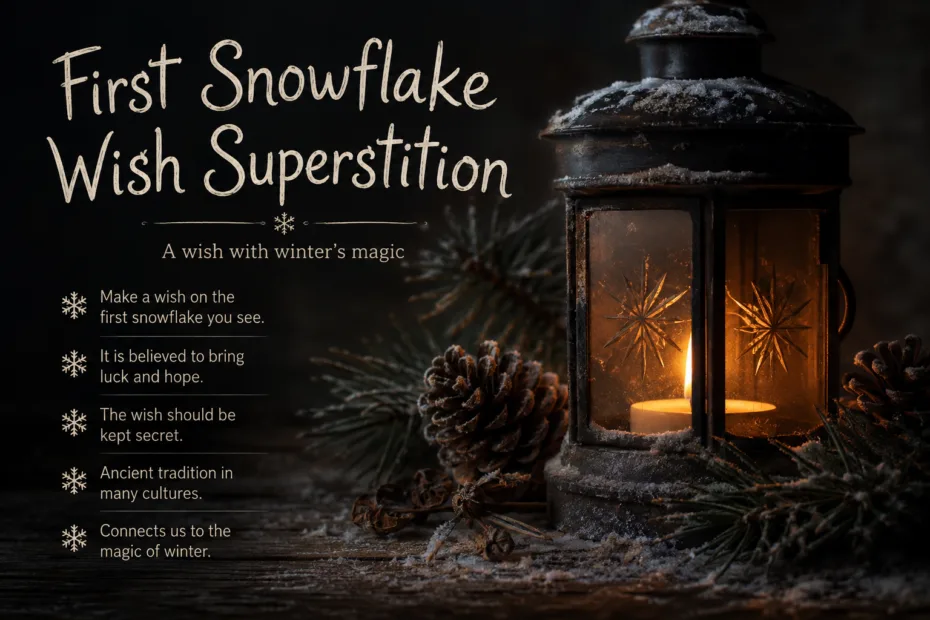
The first snowflake wish is a seasonal folk belief in which a person makes a wish when noticing the first snowflake of winter. A documented American version says that a wish made at that moment will be granted.
The Recorded First Snowflake Belief
A clear nineteenth-century record appears in Fanny D. Bergen’s Current Superstitions, published for the American Folk-Lore Society in 1896. In the chapter devoted to wishes, one entry collected in Westport, Massachusetts, states that a person should wish at the first snowflake of the season and will receive the wish.
The recorded belief is unusually simple. It does not prescribe a rhyme, a particular kind of wish, or any additional object or action. The meaningful moment is the appearance of the first snowflake of the season.
What Counts as the First Snowflake?
The historical wording refers to the first snowflake rather than the first major snowstorm or the first lasting snow on the ground. This makes the belief dependent on noticing the beginning of seasonal snowfall.
The Traditional Rule
Notice the first snowflake of the season and make a wish at that moment. In the documented Westport version, that alone is the condition attached to the wish.
Later retellings may describe catching a snowflake, closing the eyes, keeping the wish secret, or waiting for the flake to melt. Those details should not automatically be treated as part of the 1896 Massachusetts record, which does not mention them.
Why the First Snowfall Becomes a Wishing Moment
The belief belongs to a wider pattern of wish customs built around an event that is first, brief, or encountered by chance. Bergen’s collection places the snowflake tradition among other wish practices connected with such moments as seeing the first sleigh of the season, encountering a falling star, or unexpectedly meeting particular objects.
In this type of folklore, the unusual timing creates the opportunity. A person does not control when the first flake appears, and the moment can pass almost immediately. The wish therefore becomes attached to recognizing the event while it is happening.
The seasonal boundary also matters to the form of the custom. The first flake marks the arrival of winter in a visible way, so the opportunity occurs only once within the traditional logic of the belief.
A Belief That Can Be Adapted
Modern folklore records show that the basic idea can acquire more specific wishes. A twenty-first-century account collected by the USC Digital Folklore Archives from a person who grew up in Michigan describes children watching for the first snowflake and wishing specifically for a snow day. The wish was no longer simply for anything desired; it had been adapted to childhood winter life.
This does not establish one continuous version everywhere snow falls. It shows how a compact folk rule can be remembered and reshaped without losing its central structure: the first snowflake creates a brief opportunity to wish.
First Snowflake and First Snowfall Are Not Always the Same Tradition
Some contemporary traditions use the broader idea of the first snowfall rather than an individual first flake. For example, modern descriptions from South Korea include making a wish during the season’s first snowfall. That resembles the first-snowflake belief, but the two should not automatically be treated as identical or assumed to share the same origin.
The historical Westport record is more precise: its trigger is the first snowflake of the season. Keeping that wording intact helps distinguish the documented belief from later first-snow customs and regional variations.
No Fixed Rhyme or Elaborate Ritual Is Recorded
Unlike some wish traditions, the documented first-snowflake custom has no accompanying verse. Bergen’s collection records a rhyme for another wishing practice involving the first evening star, but no comparable words accompany the snowflake entry.
There is also no recorded requirement that the wish remain secret, be repeated a certain number of times, or come true within a particular period. Such additions may exist in individual or later traditions, but they are separate from the concise Massachusetts form preserved in the nineteenth-century collection.
United States
A wish made on the first snowflake of the season is believed to come true.