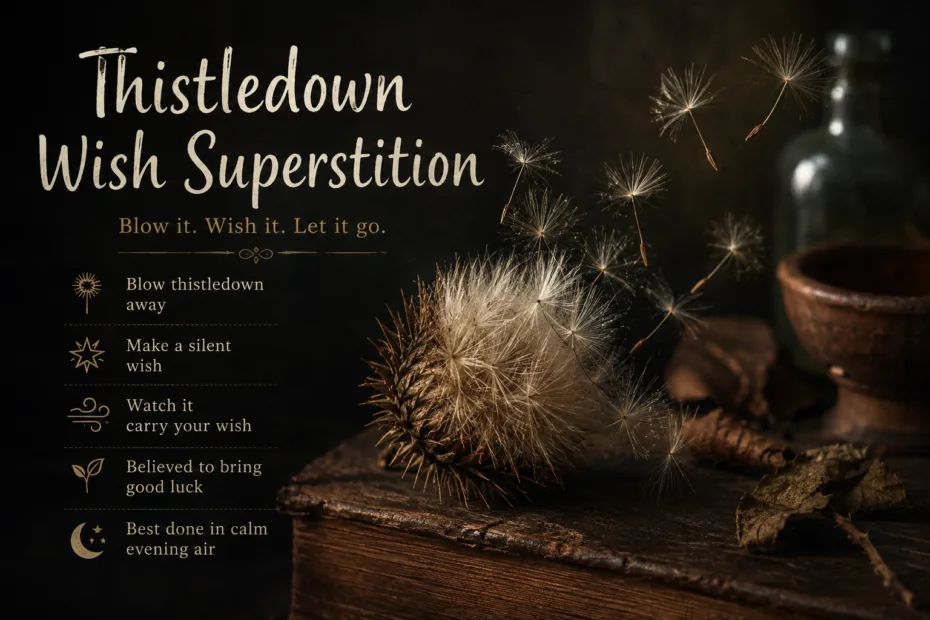
In a documented thistledown wishing custom, a person catches the light floating down, makes a wish or thinks of someone far away, then releases it into the air. Some recorded versions treat the drifting thistledown as a carrier for a message, while another makes the successful release of all the down the condition for receiving the wish.
The Ohio Wish Sent to an Absent Friend
One of the clearest historical records appears in Fanny D. Bergen’s Current Superstitions, published for the American Folk-Lore Society in 1896. The entry was recorded for Ohio and gives the thistledown a very particular purpose.
A floating piece of thistledown was to be caught and breathed upon while making a wish to see or hear from an absent friend. It was then blown in the direction where that person was believed to be, with the idea that the thistledown would carry the message.
This is more specific than a general wish for luck, money, or an unnamed future event. The wish is connected with distance and communication: someone is absent, the thistledown is released toward them, and its movement through the air represents the message traveling away.
The Ohio attribution matters. The record documents the belief in that locality; it does not establish the same wording or practice as a universal American custom.
Wishing on Wandering Thistledown
A second publication from 1896 shows that thistledown could also serve as a more general wishing object. In Plants and Their Children, Frances Theodora Parsons recalled children catching the silky objects that floated through the air, sometimes blowing one away with a message to a friend and sometimes simply wishing upon it.
Parsons placed wandering thistledown among familiar childhood occasions for making wishes. Her description is especially useful because it preserves both ideas together: the floating object could carry a message, or it could become the focus of a private wish.
Two Actions in the Early Record
- Catch and release: intercept a piece already floating through the air, make the wish, then send it onward.
- Message carrying: associate the drifting down with a friend who is somewhere else.
When Blowing Away All the Down Granted the Wish
An early twentieth-century superstition collection preserves another form of the custom. In this version, the person takes a thistle while it is in full bloom and blows on it. If all of the down flies away, the wish is expected to be granted.
This changes the role of the plant. The floating Ohio version begins with thistledown already traveling through the air, while this version begins with the down still attached to the thistle. The outcome depends on whether one breath successfully sends all of it away.
Floating Form
Catch, Wish, and Release
A drifting piece is caught and then blown onward, sometimes toward an absent friend.
Thistle-Head Form
Blow the Down Away
A wish is linked to removing all the loose down from a mature thistle by blowing on it.
Why the Wind Matters to the Ritual
The surviving versions share one physical action: the wish leaves with the thistledown. The material is exceptionally light and naturally drifts away when released, making the movement of the wish visible without requiring a spoken formula or permanent object.
In the absent-friend version, direction is part of the act. The thistledown is blown toward the place where the friend is thought to be. In the all-the-down version, successful dispersal becomes the test. These are related ideas, but they should not be merged into a single fixed rule.
Historical writing also shows that people did not always use the term with strict botanical precision. Parsons noted that several plants release similar white, silky, windborne material even though it is not technically thistledown. A childhood identification of something as “thistle down” could therefore depend on appearance and behavior rather than exact plant classification.
Thistledown as a Bearer of News
The wish tradition sits beside another recorded belief involving the same drifting material. One superstition collection states that thistledown blown into a window was a sign of good news.
This is not the same ritual as deliberately making a wish. No wish needs to be spoken or intentionally sent. Still, the two beliefs give the airborne down a comparable role: something arriving or departing on the wind becomes associated with a message, news, or hoped-for contact.
That connection is especially close to the Ohio custom, where the thistledown does not merely represent good fortune. It is imagined as carrying a personal message toward someone who is away.
United States
A floating thistledown is caught, breathed on with a wish or thought of an absent friend, and blown toward that person as a symbolic messenger.