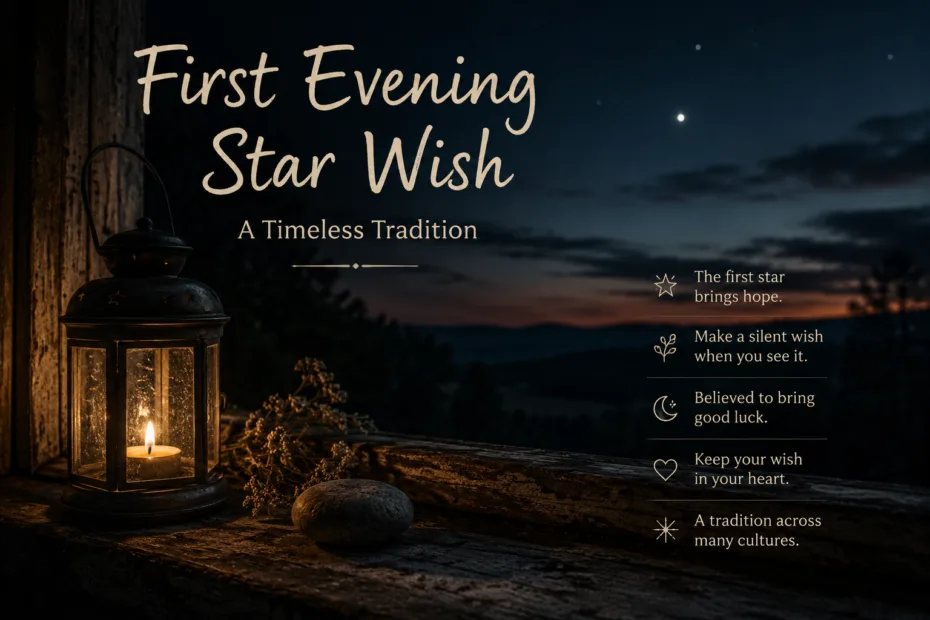
The first evening star wish is a folk practice in which the first star noticed after dusk becomes the occasion for making a private wish. In many recorded versions, the moment is accompanied by the familiar “Star Light, Star Bright” rhyme.
The First Star as the Wishing Moment
The defining condition is not simply seeing a star at night. The belief gives special value to the first star a person notices as evening begins. A wish made at that moment is traditionally said to have a chance of coming true.
Recorded forms usually connect several elements: spotting the first visible star, saying a short rhyme or formula, making a wish, and sometimes keeping that wish secret. Not every version contains every condition, and the exact wording varies.
- Timing: the wish is linked to the first star seen that evening.
- Speech: many versions use a short rhyming verse before the wish.
- Privacy: some traditions say the wish should not be revealed afterward.
- Order: in certain remembered versions, the star must be seen before the rhyme and wish are made.
The “Star Light, Star Bright” Rhyme
The best-known verbal form attached to the custom is the English-language rhyme:
Star light, star bright,
First star I see tonight;
I wish I may, I wish I might,
Have the wish I wish tonight.
The verse addresses the star directly and identifies it as the first one seen that night. The final lines express the wish without stating what the person actually wants. In practice, the desired wish may be spoken afterward or kept entirely in the person’s thoughts.
The rhyme has circulated with small wording changes. Historical collections include forms using “could” instead of “may,” shorter versions that lead directly into the wish, and other local alterations. This variation is normal for a rhyme transmitted through families, children, and oral repetition.
Recorded Forms in Nineteenth-Century New England
The first-star wish was being documented as folklore in the United States by the late nineteenth century. Fanny D. Bergen’s 1896 collection Current Superstitions records an eastern Massachusetts belief in which a person says the familiar rhyme when the first star appears, makes a wish, and does not tell anyone what was wished for.
Another 1896 collection, Clifton Johnson’s What They Say in New England, preserves a more demanding form. In that version, a person must see one star before any others for seven consecutive nights and repeat the rhyme while observing a rule of silence. Johnson also recorded shorter first-star verses, showing that there was no single fixed procedure even within New England.
A Regional Record, Not a Universal Rule
These written examples document particular New England traditions. They do not show that every household, community, or region followed the same conditions.
First Evening Star and Shooting Star Wishes Are Different
The first-star wish is often grouped together with wishing on a shooting star, but the two customs use different moments in the sky.
First Evening Star
The important feature is being first: an ordinary star-like point becomes the wishing star because it is the first one noticed as the sky darkens.
Shooting Star
The wish depends on seeing a brief streak of light, traditionally called a falling or shooting star. Its rarity and short duration form the special condition.
Historical folklore collections can record both beliefs separately. This distinction matters because the first evening star custom does not require a meteor or any unusual celestial event.
Why Secrecy Appears in Some Versions
Keeping the wish secret is one of the recurring conditions attached to the tradition. In the eastern Massachusetts form recorded in 1896, revealing the wish was specifically forbidden. Similar secrecy rules continue to appear in later personal accounts of learning the custom.
This makes the unspoken wish part of the ritual itself. The rhyme can be said aloud, while the actual desire remains private. Other versions are less strict and allow the person to state the wish after the rhyme.
Secrecy therefore belongs to a documented branch of the belief rather than to an unchanging rule that applies to every first-star wish tradition.
How the Tradition Is Passed On
Later folklore records often place the first-star wish in childhood. People describe learning the rhyme from parents, using it while watching the evening sky, and sometimes teaching it to younger siblings or children.
This kind of transmission helps explain why wording and rules differ. A family may preserve the four-line rhyme exactly while changing when the wish is made. Another version may require silence, while another only requires seeing the first star. Some people remember deliberately waiting for the first star; others used the rhyme only when they happened to notice one.
The stable part is the association between first sight, evening sky, rhyme, and wish. The smaller rules around that sequence remain flexible.
When the “First Star” Is Actually Venus
The bright point seen first after sunset is not necessarily a star in astronomical terms. Venus can appear very bright in the western evening sky and has long been called the Evening Star. When it is favorably positioned, it can outshine every true star nearby.
For the folk custom, astronomical classification is usually beside the point. The tradition depends on what the observer recognizes as the first star-like light of evening. A person following the custom may therefore direct the rhyme toward Venus without realizing that the object is a planet.
The Core Belief and Its Variable Rules
Across the documented forms, the central idea remains simple: the first star noticed in the evening creates a special opportunity to make a wish. The familiar rhyme gives that moment a verbal form, while secrecy, repetition, silence, and the exact order of actions vary between records.
The tradition is especially well preserved in American folklore collections and childhood recollections. Its surviving variants show how a short wishing custom can remain recognizable even while families and communities alter its wording and conditions through oral transmission.
United States
A person recites a first-star rhyme, makes a private wish, and expects the wish to come true if it is not disclosed.