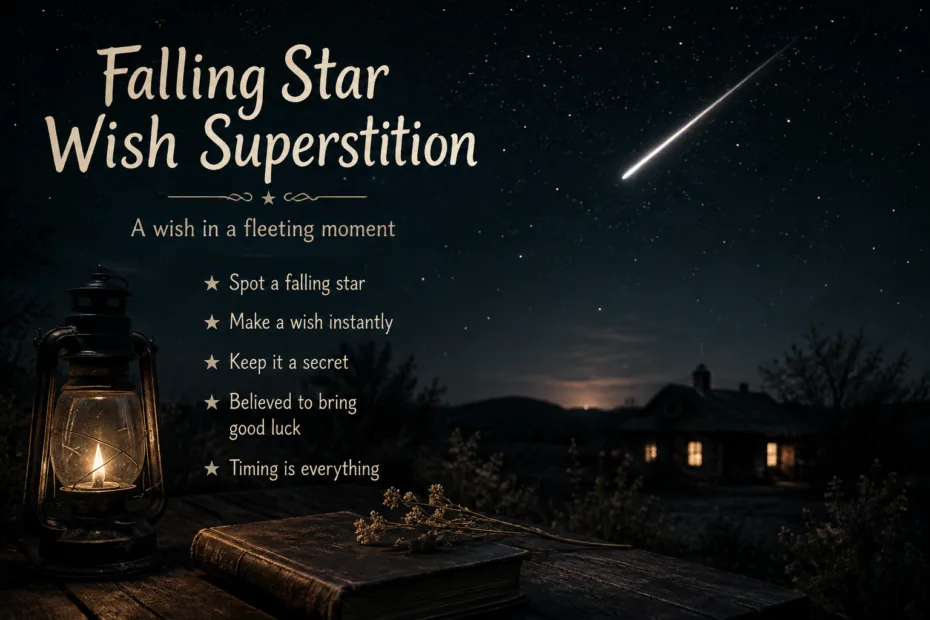
A familiar folk belief says that seeing a falling or shooting star creates a brief chance to make a wish. In many recorded versions, the wish must be made immediately, and some add conditions such as keeping it secret or finishing it before the streak disappears.
What the Falling Star Wish Belief Says
The simplest form of the superstition is direct: see a falling star, make a wish, and the wish may come true. The sighting itself creates the opportunity. No special object has to be carried, and many versions do not require a spoken formula.
Folklore records also show that the rule was not completely fixed. Depending on the version learned by an informant, the person might need to wish immediately, finish the wish while the star is still visible, avoid telling anyone what was wished for, or simply think of the wish silently.
The sight of the falling star is enough to create the wishing opportunity.
Some versions require the wish to be completed during the few seconds in which the meteor remains visible.
In another common pattern, telling someone the wish can prevent it from coming true.
A Printed Record from 1896
The falling-star wish was already being collected as oral folklore in the nineteenth century. Current Superstitions, edited by Fanny D. Bergen and published for the American Folk-Lore Society in 1896, includes a short New Jersey record instructing a person to wish upon seeing a falling star.
The placement of the record is useful because the same collection lists several other wish-making customs nearby. These include wishing at the first snowflake, using a wishbone, and wishing on the first star of the evening. The falling-star belief therefore appears as one member of a broader family of customs in which an unusual or fleeting moment becomes an opportunity for a wish.
The Wish Often Has to Be Made Quickly
Later folklore collections preserve a more demanding version of the rule. Records in the James T. Callow Folklore Archive include forms stating that a wish made on a shooting star will come true only if it is made before the star disappears.
This condition fits the visual event closely. A shooting star may be visible for only a short moment, so there is little time to decide what to wish for. The resulting custom becomes both a belief and a small spontaneous ritual: notice the streak, form the wish, and complete it before the opportunity is gone.
Some recorded versions simply say to make a wish. Others add speed, silence, secrecy, or concentration. These differences are normal in oral tradition and do not necessarily represent separate superstitions.
Why Keeping the Wish Secret Appears in Some Versions
Secrecy is not present in every falling-star record, but it appears repeatedly in modern oral accounts. One form says to think of the wish immediately and keep it to oneself; another says that revealing the details will prevent the wish from coming true.
This rule is also found in other wishing customs. The secret wish is treated as something that should remain private until its hoped-for result occurs. As a result, the spoken or unspoken wish becomes part of the performance rather than merely a thought inspired by seeing the meteor.
Falling Star Wishes and First Star Wishes Are Not the Same Rule
The falling-star superstition is often blended with the custom of wishing on the first star seen in the evening, but historical collections record them separately.
The trigger is a moving streak of light that appears suddenly. The wish may have to be made immediately or before the streak vanishes.
The trigger is the first visible star noticed after night begins. Some versions use a rhyme and require the wish to remain secret.
The well-known “Star Light, Star Bright” tradition belongs primarily to the first-star custom rather than requiring a falling star. Oral transmission can easily merge the two because both connect a visible event in the night sky with wish-making.
The Ptolemy Origin Story Is Less Certain Than Often Claimed
A popular explanation traces the modern custom directly to the second-century scholar Claudius Ptolemy. Modern retellings sometimes claim that falling stars appeared when gods opened the heavens to look down at human beings, making that moment especially favorable for requests.
The surviving material commonly published under Ptolemy’s name does discuss shooting stars as omens, but it does not provide clear evidence for the familiar modern instruction to make a personal wish when one appears. The frequently repeated story should therefore be treated as a proposed historical explanation rather than a firmly demonstrated origin.
This distinction matters because the wish custom itself is directly documented in later folklore collections, while a continuous line connecting those records to a specific classical account is harder to establish.
Other Meanings Could Exist Beside the Wish
A falling star has not always been interpreted as fortunate. Folklore archives contain records connecting shooting stars with death, souls, weather, money, good luck, and even bad luck. One recorded Michigan belief from the twentieth century describes wishing on a falling star as unlucky, while other records from the same archive say that such wishes will come true.
These contradictions show why the wish interpretation should not be presented as the universal meaning of a falling star. Folk belief can vary between families, communities, generations, and individual informants even when the same natural event is being observed.
Why It Is Called a Falling Star
The object seen streaking through the sky is not actually a star. In astronomical terminology, the visible streak is a meteor, produced when a meteoroid enters Earth’s atmosphere and becomes visible.
“Falling star” and “shooting star” remain useful terms in folklore because they describe how the event appears to an observer. The superstition belongs to that observed moment: a sudden point of light crossing the night sky, followed by the immediate act of making a wish.
United States
Seeing a falling star is treated as an opportunity to make a wish.