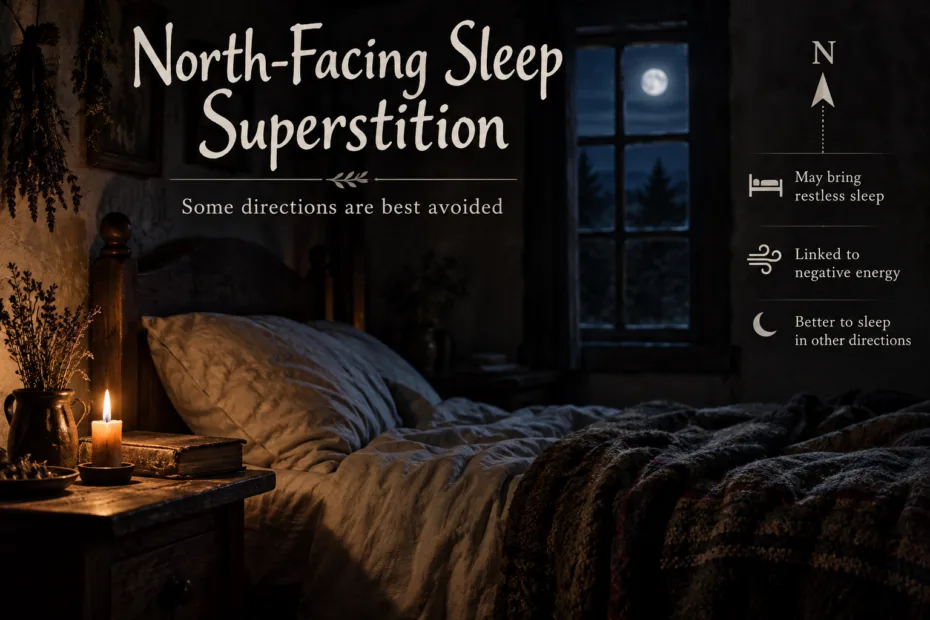
The north-facing sleep superstition warns against sleeping with the head or pillow pointing north. The best-known versions occur in Japanese and Indian traditions, although the reasons behind them are not identical.
What “Sleeping North” Actually Means
In directional sleep beliefs, “facing north” usually does not mean that a sleeping person’s face is turned toward the north. It refers to the body’s orientation: the head is placed at the northern end of the bed and the feet extend southward.
This distinction matters because the superstition is often described casually as “never face north while sleeping.” In traditions where the rule is observed, the position of the pillow or head is normally the important part.
Japan’s North Pillow Taboo
Japan has a clearly named form of the belief: kita makura (北枕), literally “north pillow.” It describes sleeping with the pillow positioned so that the person’s head points north.
The direction became closely associated with death because a deceased person may be laid with the head toward the north during Buddhist mortuary observances. Using the same orientation for ordinary sleep can therefore resemble the position prepared for the dead.
Why the Direction Is Connected with Buddhism
The Mahāparinibbāna Sutta, an account of the Buddha’s final days, describes a couch being prepared for him with its head toward the north between two sal trees. He then lay on his right side before his final passing. This scene became part of the religious background associated with the northward position.
Within Japanese folk practice, the resemblance between an ordinary bed and a mortuary arrangement explains much of the discomfort surrounding kita makura. A living person who sleeps that way may be said to invite bad luck, misfortune, or an unwanted association with death.
The taboo does not mean that every Japanese household treats a north-facing pillow in exactly the same way. Folk observance varies, and some people know the custom without personally avoiding the direction.
Northward Sleep in Indian Directional Traditions
A separate prohibition appears in Indian traditions connected with Vastu Shastra and directional rules for sleeping. In common Vastu practice, sleeping with the head toward the north is discouraged, while the south or east is often recommended.
The reasoning is not simply the Japanese kita makura belief transferred to another culture. Indian explanations belong to their own systems of directional symbolism, bodily balance, ritual ideas, and later popular interpretations.
Modern discussions of Vastu often explain the rule through the Earth’s magnetic field, sometimes claiming that a northward head position disturbs circulation, sleep, or bodily energy. Such statements are best understood as traditional or popular explanations rather than established effects of sleeping direction. The magnetic explanation has become especially common in contemporary retellings of the belief.
Similar Rule, Different Reasoning
| Tradition | Position Avoided | Main Folk Association |
|---|---|---|
| Japanese kita makura | Head or pillow toward north | Mortuary positioning, the Buddha’s final resting orientation, bad luck |
| Vastu-related Indian practice | Head toward north | Directional imbalance and undesirable effects attributed to the orientation |
The similarity can make these beliefs look like a single pan-Asian superstition. They are better treated as distinct traditions that happen to discourage the same sleeping orientation. Their meanings, religious backgrounds, and explanations developed within different cultural settings.
Why Sleeping Positions Become Superstitions
Sleep makes directional rules especially noticeable because a bed fixes the body in one position for many hours. Once a particular orientation becomes connected with funerals, ritual order, or an undesirable symbolic direction, arranging an ordinary bed in the same way can acquire additional meaning.
In the Japanese case, the connection is unusually direct: a northward pillow can reproduce a position associated with the deceased. The warning therefore works partly through ritual resemblance. A position regarded as proper for death is avoided during everyday life.
Directional traditions can also turn ordinary household choices into symbolic acts. Moving a pillow to the opposite end of a room requires little effort, so a belief may remain part of family practice even when the person following it does not expect a literal consequence.
What Is Supposed to Happen if Someone Sleeps North?
There is no single fixed omen attached to every version of the superstition. In Japanese accounts, northward sleep is most commonly described as inauspicious because of its association with death. Popular versions may speak more directly of bad luck or an early death, but these stronger predictions should not be treated as universal wording of the custom.
Vastu-based versions more often describe northward sleep as undesirable for rest, health, balance, or personal well-being. The exact claimed consequence varies between teachers, households, and modern retellings.
For that reason, “sleeping north brings death” is too broad as a definition of the belief. The more accurate core idea is that placing the head toward north is considered an unfavorable sleeping orientation in certain traditions, with the reason depending on the cultural context.
The Bed, Not the Building, Determines the Direction
A north-facing house and a north-facing sleeping position are not the same thing. These beliefs concern the direction from the sleeper’s feet toward the head. A house can face north while the person inside sleeps with the head east, south, west, or north.
Likewise, turning the face to one side during sleep does not normally change the traditional classification. If the pillow remains at the northern end of the bed, the sleeper is still in a north-head position even when lying on the side and looking east or west.
Kita Makura Can Carry More Than One Interpretation
Although the best-known Japanese interpretation treats kita makura as unlucky, folk traditions are rarely perfectly uniform. Alternative modern interpretations sometimes give northward sleep positive associations, including claims about prosperity or restful sleep.
These versions do not erase the older mortuary association. They show that a familiar superstition can be reinterpreted while its original taboo remains widely recognizable. The phrase kita makura itself continues to identify the north-pillow position regardless of whether an individual treats it as unlucky, harmless, or favorable.
United States
Sleeping with the head oriented toward the north is believed to help prevent sickness.