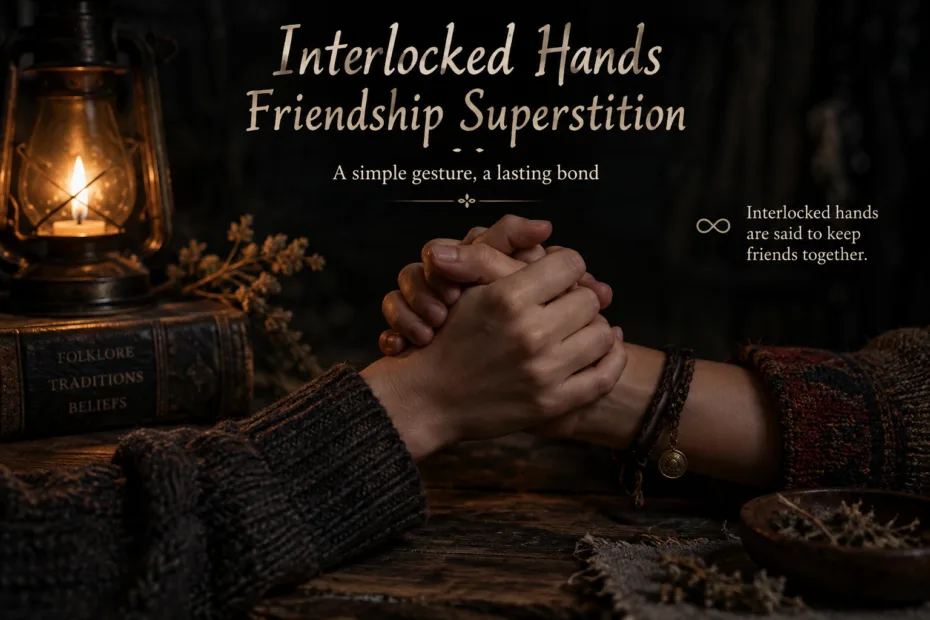
A recorded New England superstition warned that two people who clasped hands with their fingers locked together risked breaking their friendship.
The Recorded Belief
The belief appears in Current Superstitions: Collected from the Oral Tradition of English Speaking Folk, edited by Fanny D. Bergen and published for the American Folk-Lore Society in 1896. The entry was recorded specifically from Newton, Massachusetts.
The gesture was more precise than simply holding hands. Two people were described as clasping each other’s hands so that their fingers locked together and their palms met. According to the recorded superstition, doing this would break the friendship between them.
The surviving record links the omen to Newton, Massachusetts. It does not establish that the belief was shared throughout New England or the United States.
Why the Exact Hand Position Matters
The warning concerned interlocked fingers between two people, not every handshake or friendly handclasp. That distinction matters because hand gestures carried several different meanings in nineteenth-century folklore.
The same 1896 collection places the Newton belief beside other traditions involving hands and friendship. An Alabama entry says that two people washing their hands at the same time would remain friends forever. Another belief, recorded in the Province of Quebec, says that two people placing their palms flat against each other would quarrel.
These records show how a small change in an everyday action could completely change its predicted result. Washing together could indicate lasting friendship, while touching palms or locking fingers could be associated with conflict or separation.
Interlocked Fingers Did Not Always Mean Broken Friendship
Interlocking fingers should not be treated as a universal symbol of damaged friendship. Historical records of gesture also preserve almost the opposite meaning.
Nineteenth-century descriptions of gesture signs include linked or interlocked fingers as representations of friendship, union, companionship, or peace. Some accounts explain the gesture through the simple visual idea of two separate parts being joined together.
This makes the Newton superstition especially specific. The same basic image of joined hands could symbolize closeness in one tradition while functioning as an omen of separation in another. The meanings belong to their individual folklore contexts rather than to the hand position itself.
A Friendship-Breaking Omen Rather Than a Ritual
The recorded Newton entry describes a predicted consequence, not a ceremony for deliberately ending a friendship. There is no accompanying spoken phrase, counter-charm, required number of repetitions, or recorded method for undoing the omen.
It is therefore best understood as a small behavioral superstition: avoid locking fingers palm-to-palm with a friend because the act was said to threaten the relationship. The historical record preserves the warning itself but does not explain how the association began.
United States
Two people clasping hands with interlocked fingers and palms together are believed to risk breaking their friendship.