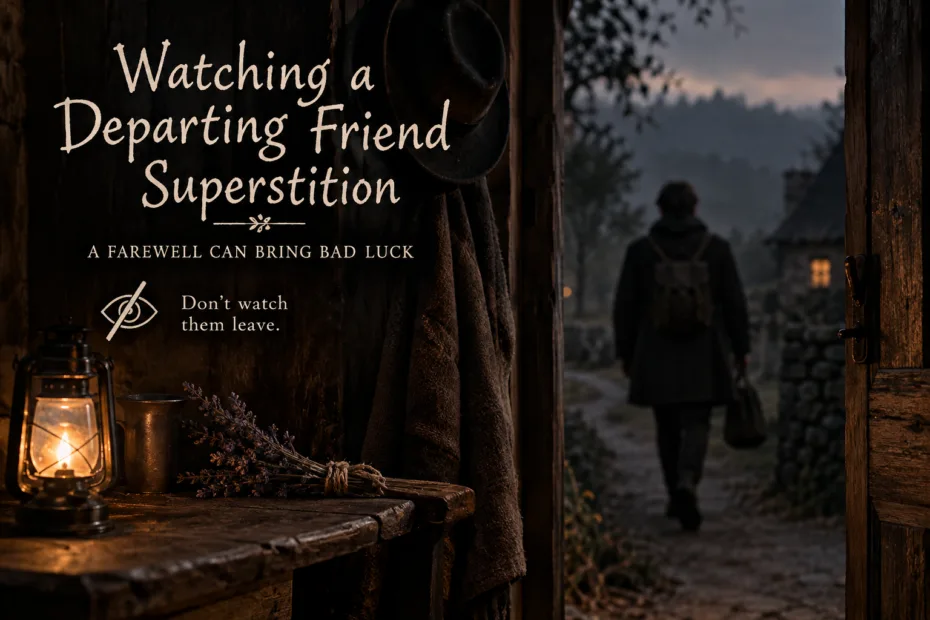
A documented American superstition warns against watching a departing friend until they disappear from view. According to the belief, if the person is watched completely out of sight, the two friends may never see each other again.
The Superstition
The rule concerns the final moment of a farewell. A friend may be watched as they walk or travel away, but the observer is supposed to look away before the departing person disappears completely.
The feared consequence is separation rather than ordinary bad luck. In traditional versions, watching the friend vanish from sight is treated as an omen that the departure could become permanent.
Traditional Form
The safest action within the belief is simple: stop watching while the departing friend is still visible.
A Recorded American Folk Belief
The superstition was already being collected in the United States in the nineteenth century. Fanny D. Bergen’s Current Superstitions, published by the American Folk-Lore Society in 1896, records the belief among the oral traditions of English-speaking people in the United States.
Its version states that a person should not continue looking after a departing friend until the friend is entirely out of sight. Instead, the observer should turn away while the person can still be seen, with the expectation that the friend may then return.
Clifton Johnson documented essentially the same belief in What They Say in New England, also published in 1896. His collection places it among beliefs specifically concerning friends and the preservation of friendship.
The Meaning of Disappearing from Sight
The important moment is not the goodbye itself. It is the instant when the departing person becomes invisible.
Within the logic of the superstition, visual disappearance mirrors lasting separation. Allowing a friend to vanish while still being watched symbolically completes the departure. Looking away beforehand interrupts that sequence.
This helps distinguish the belief from a rule against seeing someone off. Accompanying a friend to a door, gate, road, station, or other point of departure is not inherently forbidden. The warning applies specifically to watching the person all the way out of sight.
The Belief in Later Oral Tradition
The idea did not disappear with nineteenth-century folklore collections. The James T. Callow Folklore Archive at the University of Detroit Mercy preserves a Detroit record learned in 1972 with almost the same warning: when a friend leaves, do not watch that person go completely out of sight or you may never see them again.
The collector’s note connects that particular instance with a farewell between romantic partners, showing that friend in actual oral use could include a boyfriend or another person with whom continued contact mattered.
The archive classifies the record as a departure, goodbye, relationship, and superstition belief. Its close resemblance to the nineteenth-century versions shows that the same farewell rule was still circulating in American oral tradition generations later.
What the Superstition Does and Does Not Say
- It does not forbid saying goodbye.
- It does not require leaving without looking back.
- It does not say that merely watching someone begin to leave is unlucky.
- The warning begins when the observer continues watching until the departing person has completely vanished from sight.
- The traditional consequence is that the two people may not meet again.
Historical records support this fairly narrow form of the belief. Broader claims that watching any departure causes misfortune, death, or harm belong to different farewell and journey superstitions and should not automatically be treated as versions of this one.
United States
Watching a departing friend until the person disappears is believed to prevent a future meeting; looking away before they vanish is thought to favor return.