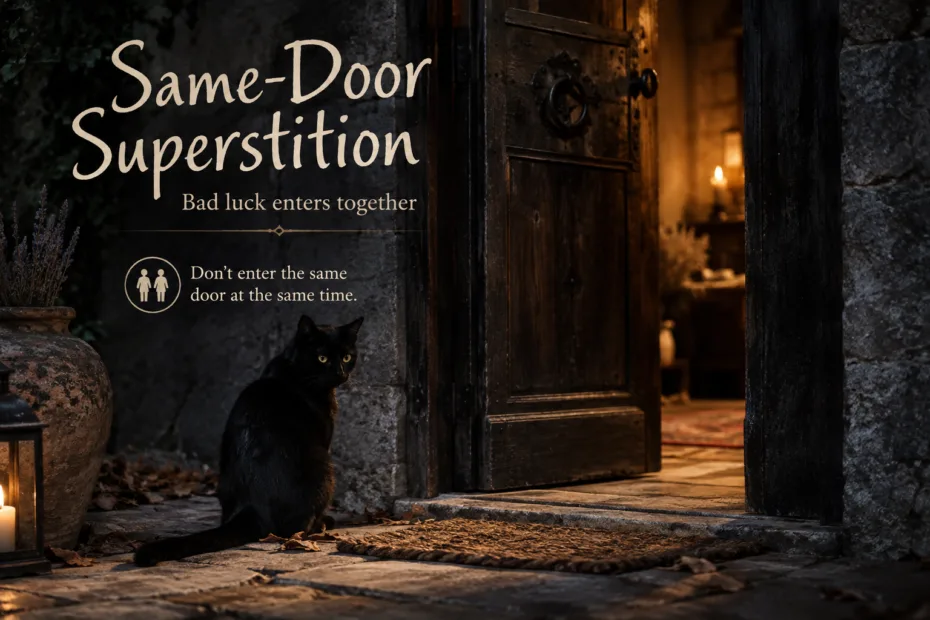
The same-door superstition holds that a person should leave a house or building through the same door used to enter it. Leaving by another door is traditionally associated with bad luck.
The Same-Door Rule
In its simplest form, the belief follows a clear sequence: enter through one door and leave through that same door. A visitor who enters through the front door, for example, is expected to use the front door again when departing rather than leave through a back or side entrance.
The rule appears mainly as a household and visiting superstition. Recorded versions also extend it to other buildings, where the important detail is not which door is used but whether the entrance and exit match.
Breaking the pattern is usually said to bring bad luck. The exact consequence is often left unspecified, which is common in orally transmitted household beliefs.
Who Is Supposed to Receive the Bad Luck?
Not every version assigns the consequence to the same person. Some accounts say the visitor who leaves through a different door will experience bad luck. Others extend the effect to the homeowner or the household itself.
One recorded form states that both the departing visitor and the people living in the home may be affected. Another narrows the consequence to bad luck for the rest of the day. These differences show that the stable part of the belief is the same-door requirement, while explanations of what happens after breaking it can change between families and communities.
Front Door and Back Door Versions
A familiar form of the superstition specifically contrasts the front and back doors. Someone who enters through the front door should not leave through the back door.
In this version, front and back are not necessarily treated as inherently lucky or unlucky. The problem is the change of route. The same logic can therefore apply in reverse: entering through the back and leaving through the front also breaks the expected pattern.
The superstition concerns matching the exit to the original entrance, rather than requiring one particular door for everyone.
Recorded Exceptions and Variations
Folklore records preserve several variations rather than one fixed rule.
- Some versions apply whenever a person enters a house or building.
- Another recorded form applies specifically when entering a house for the first time.
- Some traditions focus on guests visiting another person’s home.
- One variation allows a person to leave through a different door if they have first sat down inside the house.
- In another telling, going in one door and immediately out another is treated differently from staying for a normal visit.
The sitting-down exception changes the structure of the belief. Instead of requiring the same physical route in every circumstance, it treats a brief pause inside the house as enough to interrupt the direct movement from one doorway to another.
Taking the Household’s Luck Away
Most recorded forms simply warn of bad luck without explaining why. A more specific version says that a person entering through one door and leaving through another may carry the home’s good luck away.
This interpretation shifts attention from the visitor to the house. The doorway becomes part of a sequence in which arrival and departure are expected to balance each other. Leaving by the original entrance preserves that sequence, while departing elsewhere is treated as disrupting it.
Leaving the Visit Properly Closed
Some family accounts give the rule a different explanation. Returning through the same doorway can represent the proper completion of a visit, meal, gathering, or other occasion. Entering and leaving at the same point gives the event a defined beginning and end.
This explanation is not present in every telling and should not be treated as a single historical origin for the superstition. Many recorded examples preserve only the instruction and the warning of bad luck, with no explanation attached.
A Belief Preserved Through Everyday Routine
The same-door superstition requires no object, spoken phrase, or formal ceremony. It survives through a simple action: remembering which doorway was used on arrival and returning to it when leaving.
Folklore collections preserve accounts of people who followed the practice themselves, expected guests to follow it, or learned it from parents, grandparents, friends, and other family members. This kind of transmission helps explain why the rule can remain recognizable even when the reason given for it differs from one telling to another.
United States
Leaving a house by a different door from the one used to enter is believed to bring family trouble or personal bad luck.