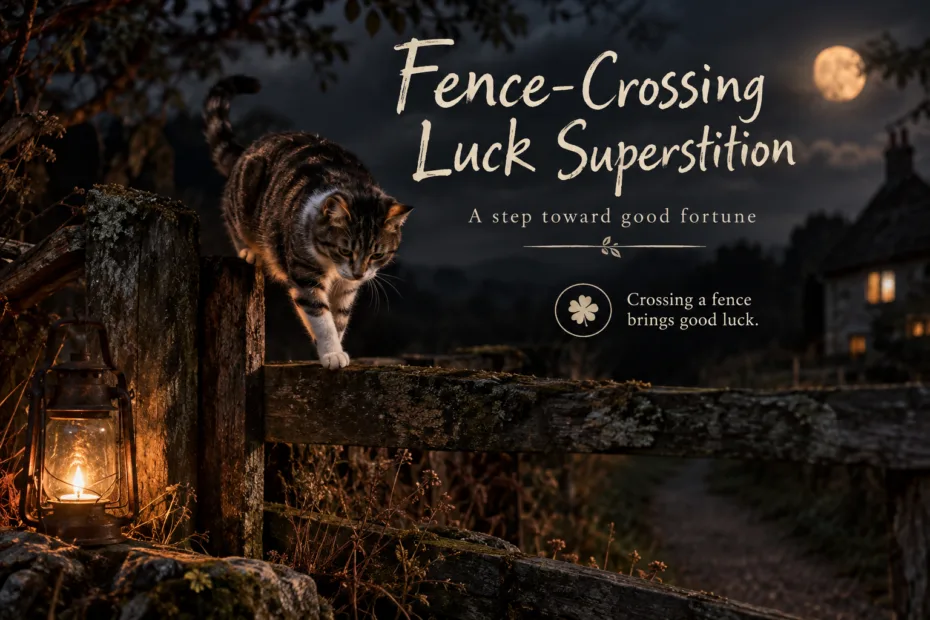
Recorded fence-crossing superstitions do not give one universal rule. Older folklore collections instead preserve several related beliefs in which how, when, or where a fence is crossed could affect a person’s luck.
What the Fence-Crossing Belief Says
One of the clearest American records appears in Fanny D. Bergen’s Current Superstitions, published in 1896 from material collected from English-speaking oral tradition. A belief recorded in western Massachusetts states that crawling under a fence brings bad luck.
Other collections preserve different rules. An early twentieth-century compilation warns against jumping a fence when beginning a journey. The same source records a Welsh form in which seeing someone jump over the first fence was treated as an ominous sign.
These records show why the belief is better understood as a family of fence-crossing superstitions rather than a fixed rule that applied everywhere. Crossing over, going through, crawling underneath, or crossing at a particular moment could carry different meanings.
Over, Through, or Under
An older rhyme attached different outcomes to three ways of negotiating a fence:
“Get over, meet with a clover;
Get through, meet with a shoe;
Get under, meet with a blunder.”
The rhyme turns an ordinary rural obstacle into a small luck test. Going over is paired with clover, a plant already associated with fortunate symbolism in popular tradition. Going under ends with a “blunder,” matching the separately recorded Massachusetts warning against crawling beneath a fence.
The middle line does not clearly define whether meeting with a shoe is fortunate or unfortunate. Its value lies in preserving the traditional rhyme, not in supplying a single interpretation that the record itself does not provide.
Why the First Fence Could Matter
The journey variant places special weight on the first boundary crossed after setting out. In this form, the fence is not merely part of the landscape. Its position near the beginning of a trip makes the action an omen for what follows.
This fits a broader pattern found in older folk belief in which beginnings were watched closely for favorable or unfavorable signs. Starting a journey, leaving a house, taking a first step, or encountering something early on could acquire more meaning than the same action later in the day.
The surviving fence records should not, however, be expanded into a universal rule about travel. They document particular beliefs collected in specific places and periods.
The Fence as a Dividing Line
Related folklore also treated the fence itself as a meaningful separation between people or spaces. A Maryland folklore collection from the late nineteenth century records shaking hands over a fence as unlucky. Kentucky material later preserves a similar warning about shaking hands across either a fence or a gate.
These examples concern interaction across a boundary rather than physically crossing it, but they help explain why fences repeatedly appear in luck traditions. A fence marks a visible division: one person stands on one side and another person, road, field, or destination lies beyond it.
The same distinction appears in household superstitions concerning doors, gates, and thresholds. The precise rule changes from one record to another, while the boundary remains the feature around which the action is organized.
Historical Scope of the Superstition
The strongest documentation for these forms comes from folklore collected during the late nineteenth and early twentieth centuries. The records preserve beliefs that collectors heard or compiled; they do not establish that everyone in the named region followed them or that the customs remain current there.
Recorded Forms
- Crawling under a fence was recorded as bad luck in western Massachusetts.
- Jumping a fence at the start of a journey was warned against in an early folklore compilation.
- A Welsh record linked jumping the first fence with an ominous prediction.
- An older rhyme assigned different outcomes to going over, through, or under a fence.
- Shaking hands across a fence was independently recorded as unlucky.
Rather than describing a single worldwide superstition, these records preserve several ways that crossing or reaching across a physical boundary became connected with luck, journeys, and omens in older folk tradition.
United States
The way a person crosses a fence—over, through, or under—is associated with different outcomes such as clover, a shoe, or a blunder.