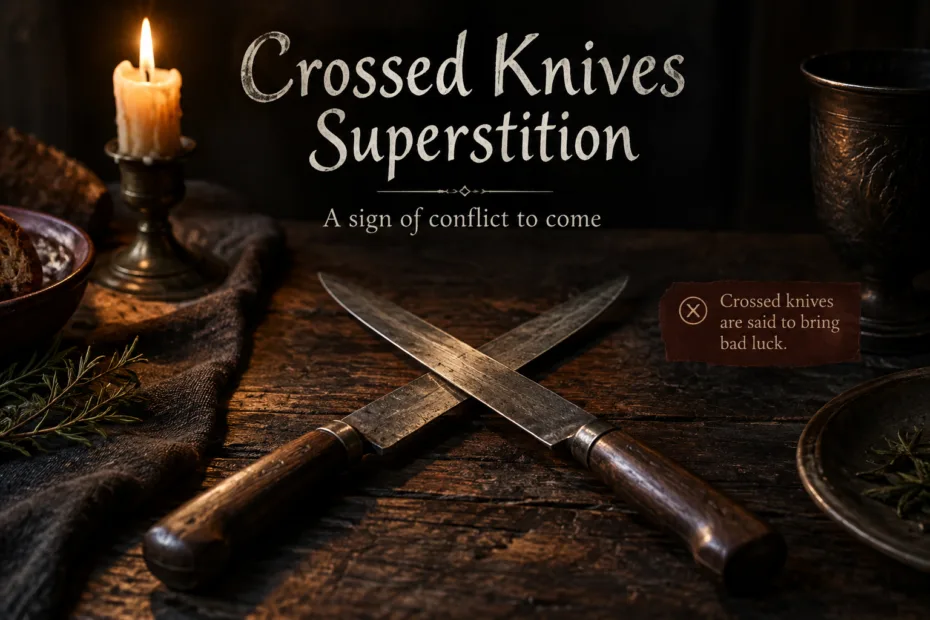
The crossed knives superstition treats two knives lying across one another as an omen of quarrelling, conflict, or trouble between people. Older records show the belief in several English-speaking traditions, although the predicted consequence varies from an argument at the table to a broader disturbance in the household.
What Crossed Knives Are Said to Mean
In its most common form, the superstition applies when two knives are accidentally left crossing each other, usually on a dining table. The crossed blades are interpreted as a warning that an argument or disagreement may follow.
The omen does not usually depend on a particular angle or elaborate arrangement. It is the simple crossing of one knife over another that matters. Some versions place the expected quarrel among the people sharing the meal, while others extend it to the household generally.
Crossed knives are traditionally associated with conflict between people. Older descriptions use terms such as a quarrel, a fight in the house, or approaching trouble rather than assigning one fixed consequence to the omen.
The Quarrel Association in Older Folklore
The connection between crossed knives and disagreement was already being recorded in folklore collections by the nineteenth century.
Fanny D. Bergen’s Current Superstitions, a collection of beliefs from English-speaking oral tradition, records a belief from Cumberland, Massachusetts: crossed knives were considered a sign of a quarrel.
Welsh folklore recorded another form of the belief. Crossing a knife and fork was considered unlucky, while two crossed knives were associated with approaching misfortune.
A record preserved in Ireland’s Schools’ Collection gives the belief in especially direct language: crossed knives meant a fight in the house.
These records show that the superstition did not have one rigid wording. The recurring idea was that crossed blades represented or foretold some form of interpersonal trouble.
Why Knives Became Linked With Arguments
Folklore records establish the association with quarrelling more clearly than they establish its original explanation. There is no single securely documented event from which the superstition can be traced.
The imagery nevertheless fits the belief closely. A knife already carries associations with cutting, sharpness, separation, and potential conflict. Placing two blades across one another creates an image of opposition. This makes the later association with disagreement easy to understand, but such symbolism should not be treated as proof of the superstition’s historical origin.
Language may also reinforce the idea. Some orally transmitted versions connect knives with sharp words, turning the physical sharpness of the utensil into a metaphor for hostile conversation. In these versions, crossed knives at dinner anticipate an unpleasant exchange among the people at the table.
Uncrossing the Knives
The usual response is simple: separate the knives as soon as they are noticed. In some tellings, uncrossing them is treated as a way of preventing the predicted quarrel. In others, people straighten them almost automatically because crossed cutlery itself is regarded as unlucky.
This kind of corrective action is common in folk belief. The unwanted arrangement creates the omen, and immediately reversing that arrangement symbolically removes the danger. No elaborate ritual is necessary in the commonly recorded crossed-knives tradition.
Crossed Knives and Crossed Knife-and-Fork Beliefs
Not every record describes exactly the same arrangement. Some refer specifically to two knives. Others warn against crossing a knife and fork.
The distinction matters because these forms should not automatically be treated as identical. In one tradition, two crossed knives may predict a quarrel; elsewhere, crossed cutlery may simply be described as unlucky or connected with a less specific misfortune.
Most strongly associated with a quarrel, disagreement, or fight between people.
Recorded in some traditions as an unlucky table arrangement, sometimes without a narrowly defined consequence.
Accidental Crossing Matters More Than Deliberate Display
The traditional belief generally concerns an ordinary domestic moment: knives happen to be placed across each other while setting, clearing, or using a table. The arrangement is noticed and interpreted as an omen.
This differs from deliberately arranging knives in an X for decoration, storage, heraldry, or another symbolic purpose. Folklore about crossed knives is primarily concerned with the unexpected appearance of the crossed blades within everyday life, particularly around meals and household activity.
The Belief at the Dinner Table
The dining table provides a natural setting for this superstition because it combines knives with social interaction. A meal brings people together, while the omen predicts precisely the opposite condition: disagreement among those present.
Some family traditions therefore interpret crossed knives less as general bad luck and more specifically as a warning about conversation. An otherwise ordinary place setting becomes a sign that tempers may rise or that someone may exchange harsh words.
The recorded forms vary, but the underlying pattern remains consistent: blades crossed against one another are read as a sign of people becoming crossed with one another.
United States
Crossed knives are interpreted as a sign of an impending quarrel.