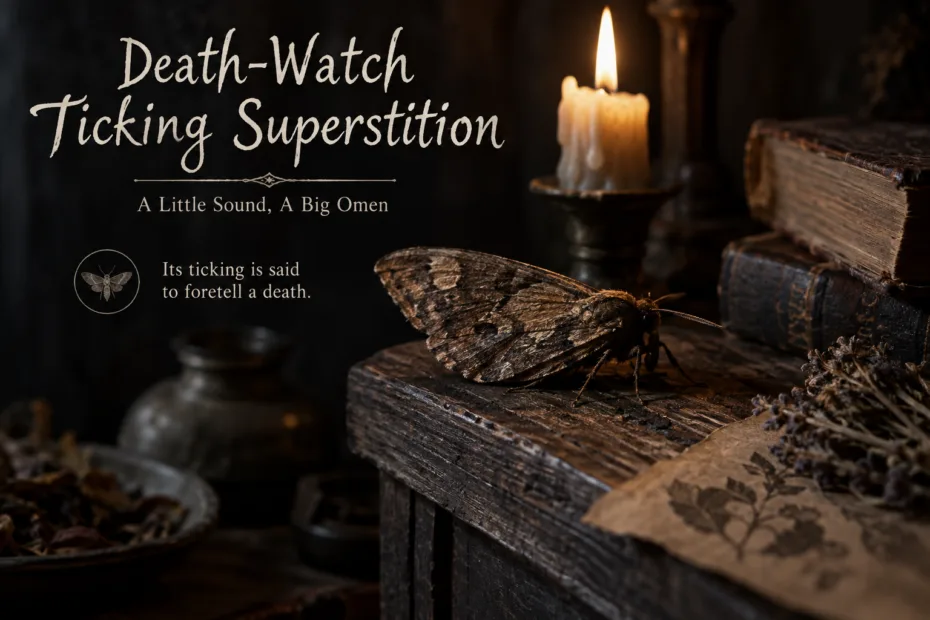
A faint, repeated ticking heard from old wood was once interpreted as a warning that someone in the household might soon die. The sound became known as the death-watch, although its best-known source is a small wood-boring beetle.
What the Death-Watch Ticking Was Believed to Mean
The superstition treated an unexplained ticking or tapping inside a house as a death omen. When the sound seemed to come from walls, furniture, beams, bedposts, or wooden panelling, it could be interpreted as announcing an approaching death among the people living there.
The belief was especially unsettling when someone was already sick. In that setting, each repeated click could be heard as a kind of countdown. The prediction was generally attached to the household rather than to a precise person: hearing the death-watch meant that someone in the house was thought to be in danger of dying.
A repeated ticking from old wood could be taken as a warning of an approaching death in the household. The sound itself, rather than seeing the insect, was the important part of the superstition.
Why a Small Ticking Sound Became Frightening
The setting helped give the sound its reputation. Death-watch insects inhabit timber, so their tapping may come from a place where the insect cannot be seen. In a quiet room, particularly at night, the regular knocks can resemble the ticking of a watch.
Older accounts repeatedly connect the sound with silence, bedrooms, old houses, wooden interiors, and periods when people were awake while others slept. A mysterious noise heard during a vigil beside a sick or dying person could therefore acquire a meaning far beyond its actual source.
The comparison with a watch also gave the omen a memorable form. A watch measures passing time; the hidden insect produced a similar rhythm. Folk interpretation linked that rhythm with the supposedly limited time remaining to someone in the house.
The Beetle Behind the Familiar Death-Watch
The insect most closely associated with the name today is the death-watch beetle, Xestobium rufovillosum. It is a wood-boring beetle found in dead timber and in wooden parts of buildings.
Adult death-watch beetles can produce the characteristic tapping sound by striking against wood. The tapping is part of their communication and mating behaviour. What people once heard as an ominous message was therefore an ordinary biological signal produced by an insect concealed in timber.
This also explains why the sound could appear to come directly from a wall, ceiling beam, piece of furniture, or bed structure. The insect did not need to be visible for its tapping to be clearly audible in a quiet room.
Repeated ticking foretells a death within the household.
A wood-dwelling insect produces audible taps against timber as a communication signal.
Why It Is Called a “Death-Watch”
The name joins two ideas that reinforced one another. “Watch” could evoke the watch-like ticking of the insect, while a death watch could also mean a vigil kept beside a dying or dead person.
The English word has been associated with the ominous insect for centuries. Merriam-Webster records the insect sense of deathwatch from 1646 and describes the name as arising from the superstition that its ticking foretells death.
The overlap between ticking, waiting, sleeplessness, sickness, and a vigil beside the dying made the expression unusually durable. The insect’s ordinary tapping and the human practice of keeping watch around death became closely joined in popular language.
The Superstition in Older Folklore
Written folklore collections show that the belief was more than a later nickname for a beetle. The ticking itself was explicitly recorded as a portent.
An early twentieth-century collection of Welsh folklore, for example, describes a watch-like insect sound that had once been regarded as a sign of death. One account tells of a household that repeatedly heard such a noise but abandoned the superstition after nobody died.
Older English writings also show attempts to challenge the belief. By the eighteenth and nineteenth centuries, authors were explaining that a creature living in old wood caused the sound, while still noting that listeners could become frightened when they heard it. The natural explanation and the superstition therefore circulated side by side for a long period.
The Ticking Rather Than the Beetle Was the Omen
The traditional belief did not require a person to find or identify a beetle. Its force came from hearing an unexplained sequence of taps. Someone might never see the insect responsible.
This distinction matters because historical writers did not always agree about which small creature produced every sound called a death-watch. Different wood-dwelling insects were sometimes discussed under the same or similar names. Modern identification most strongly associates the familiar British death-watch beetle with Xestobium rufovillosum, but older texts may use different scientific names or attribute similar ticking to other insects.
The superstition itself remained simpler than the entomology: an unseen ticking in the house, especially when it sounded like a watch in a silent room, could be interpreted as a warning of death.
A Sound That Could Be Answered
Historical natural-history descriptions record another feature that made the death-watch unusual. The insect’s tapping could sometimes provoke answering taps from another insect. Human tapping on wood was also reported to produce a response.
For someone who did not know the source, a hidden sound that appeared to repeat or answer knocks could seem deliberate. That responsive quality helped distinguish the death-watch from an ordinary creak in a building and may have strengthened the impression that the noise carried a message.
In biological terms, however, the response fits the beetle’s use of tapping for communication. The same behaviour that made the sound seem purposeful to listeners is part of what allows the insects to locate or signal one another through wood.
United States
Hearing the so-called death-watch or death-tick in a wall is interpreted as a sign of a death in the household.